
BAP vs Contractor's Pollution Liability vs Sewer Backup Endorsements: What Plumbing Fleets Actually Need
BAP vs Contractor's Pollution Liability vs Sewer Backup Endorsements: What Plumbing Fleets Actually Need
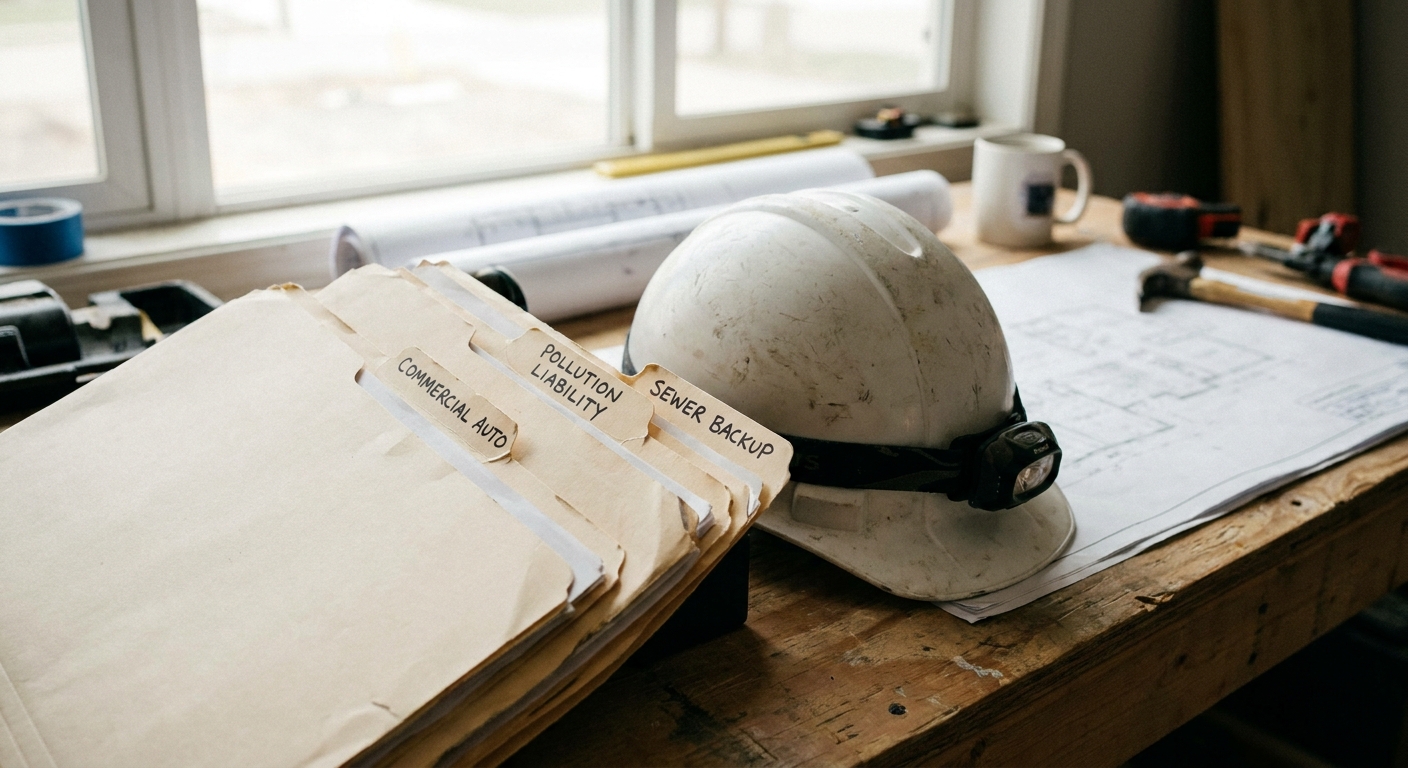
The short answer: These are three completely different insurance products solving three different problems, and plumbing contractors confuse them constantly. Business Auto Policy (BAP) covers the trucks themselves — liability if a service van rear-ends a Tesla, and physical damage if the truck rolls over. Contractor's Pollution Liability (CPL) covers pollution events caused by your operations — sewer backups into a customer's home, contaminated water releases, fuel-oil leaks, refrigerant releases. Sewer Backup endorsements on a property policy (yours or your customer's) cover damage when a municipal or shared sewer system backs up into a structure, regardless of fault — they are not contractor coverage and they don't follow you. A plumbing fleet needs BAP + CPL; you don't buy a sewer backup endorsement on your business policy because you don't have a "sewer backing up into your shop" exposure. The mistake is when contractors think the sewer backup endorsement they see on their homeowners policy applies to their work — it doesn't.
Why this confusion exists
Three things called "sewer-related insurance" all live in different parts of the market, get sold by different brokers, and respond to different claim types. A plumbing contractor with no broker-side guidance hears "sewer backup" and reaches for the wrong policy. Then a real claim happens, the wrong policy is presented to the carrier, and the claim is denied. The contractor blames "insurance" generally, when what actually failed was the program design.
This post breaks the three apart. If you haven't read the pillar yet, start with Commercial Auto Insurance for Plumbing Contractor Fleets: The Complete 2026 Guide.
Business Auto Policy (BAP) — covers the trucks
What the BAP does:
- Liability — pays third-party bodily injury and property damage when one of your trucks causes an accident.
- Physical damage — collision and comprehensive on the truck itself (the vehicle and permanently attached equipment like a truck-mounted jetter).
- Medical payments — minor injury coverage for occupants of the insured vehicle.
- Uninsured/underinsured motorist — protects you when the other driver has no insurance.
- Hired/non-owned auto — covers liability when you use rented or employee-owned vehicles for work.
What the BAP does not do: cover the work you perform with that truck. If you park the truck, get out, snake a sewer, and the sewer backs up into the customer's basement — that's not auto. That's general liability or pollution liability. The BAP doesn't see it.
Contractor's Pollution Liability (CPL) — covers your operations
CPL is a separate, standalone (or endorsement-form) policy that fills the pollution exclusion in your General Liability. It covers:
- Sudden & accidental pollution events arising from your plumbing operations — sewer backups, contaminated water releases, hot water line ruptures.
- Gradual pollution in some forms — slow fuel-oil seepage from a tank you serviced, slow contamination from a slab leak.
- Bodily injury and property damage at third-party sites caused by released pollutants.
- Cleanup costs at the customer's site, your own owned sites, and at sites you don't own but are responsible for.
- Mold resulting from a covered pollution event (water release leading to mold growth).
- Transportation pollution — your truck rolling over and releasing fuel or refrigerant.
What CPL does not do: cover the truck itself (BAP does that) or the slow degradation of a customer's plumbing system that wasn't caused by your work.
Typical CPL limits for a plumbing fleet: $1M occurrence / $2M aggregate, $5K deductible. Annual cost: $2,800–$7,500 for 5–15 truck operations.
Sewer Backup endorsements — a property coverage
This is the one that creates the most confusion. A "sewer backup endorsement" is a property coverage (on a homeowners policy or a commercial property/BOP policy) that covers your own property when a sewer or drain backs up into your building. It is NOT contractor coverage. It is NOT third-party liability. It does NOT follow you to a customer's site.
What a sewer backup endorsement covers:
- Damage to your own building when the municipal sewer line backs up through your floor drains.
- Damage to your own property contents when a sump pump fails and water enters through the foundation.
- (Some forms) Damage when a tenant's drain backs up into shared common areas of a building you own.
What it does NOT cover:
- Damage at a customer's property caused by your plumbing work.
- A sewer backup that happens while you're snaking a line and your snake punches a hole in an old pipe.
- Anything where you, the contractor, are the alleged cause.
Plumbing contractors should not be relying on sewer backup endorsements as part of their commercial program. They're a homeowners and small-property coverage. They are not a substitute for CPL.
Side-by-side comparison
| Question | BAP | CPL | Sewer Backup End. |
|---|---|---|---|
| What does it cover? | The truck | Your operations | Your own property |
| Who's the protected party? | You + 3rd parties | 3rd parties harmed by pollution from your work | You (the property owner) |
| Covers a sewer backup at a customer's house? | No | Yes | No |
| Covers a sewer backup at YOUR shop? | No | No (it's your property) | Yes |
| Covers a fuel-oil leak from work you did? | No | Yes | No |
| Covers your truck rolling over? | Yes (PD) | No | No |
| Covers fuel spill from a rolled-over truck? | Limited (statutory limit only) | Yes | No |
| Typical cost | $1,700–$2,300/truck/yr | $2,800–$7,500/yr total | $50–$300/yr |
| Required for plumbing fleet? | Yes — mandatory | Yes — practically mandatory | Optional (only if shop is at flood/sewer risk) |
Three real scenarios — which policy pays?
Scenario 1: Service truck rear-ends a sedan at a red light
Your service truck rear-ends a Toyota Camry stopped at a red light. The Camry driver claims a back injury. Settlement comes in at $42,000.
- BAP: Pays. Bodily injury liability covers the third party's injury claim. ✓
- CPL: No. No pollution event.
- Sewer Backup: No. Property coverage, irrelevant.
Scenario 2: Snake punches a hole in a cast-iron sewer line; sewage backs up into customer's finished basement
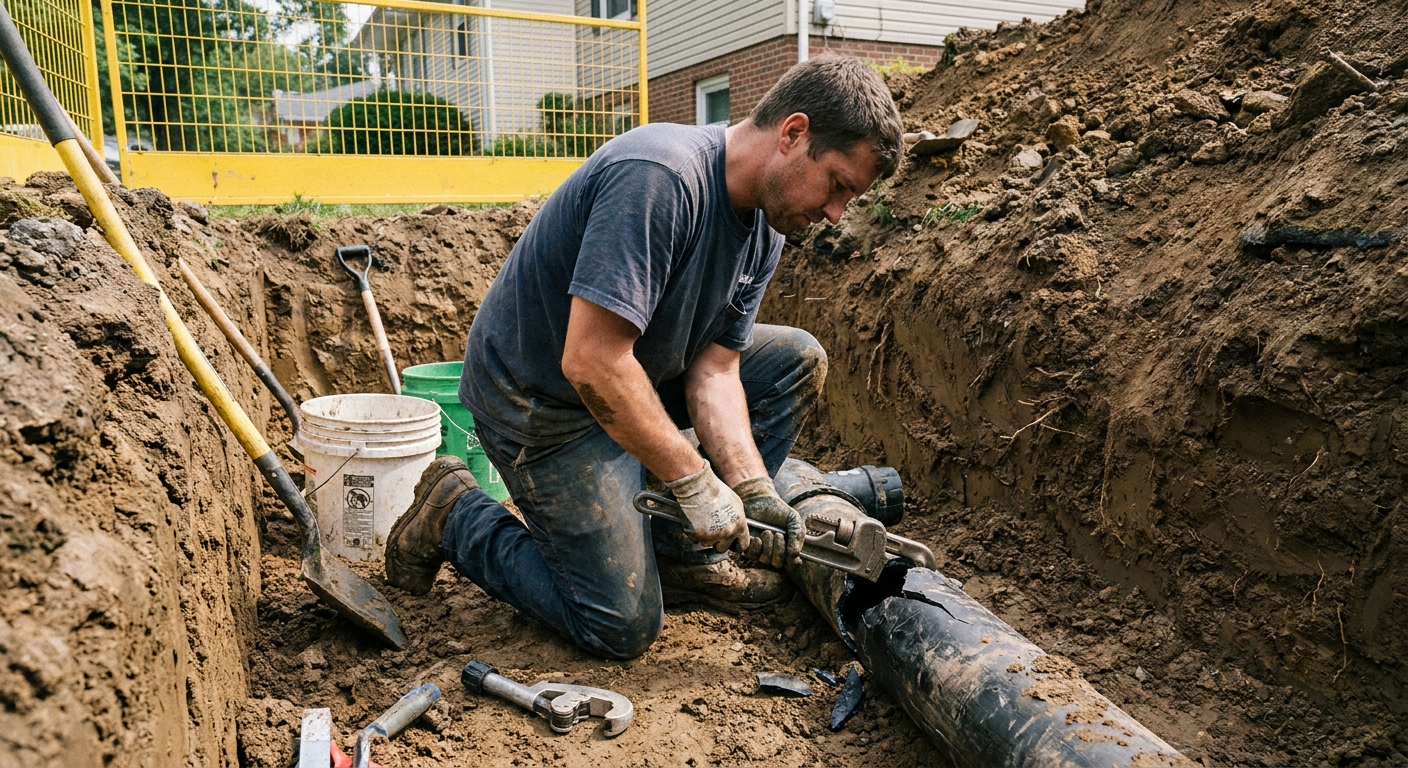
You're snaking a backed-up main sewer line in a 1960s home. The snake catches a corroded section of cast iron and punches a hole. Within 90 minutes, sewage backs up into the customer's finished basement — $135,000 in damage to flooring, drywall, framed art, and a finished bar area. Customer's homeowners pays $135K to restore the basement, then subrogates against you for the full amount.
- BAP: No. Auto policy doesn't see this.
- GL (commercial general liability): Denies — pollution exclusion applies. Sewage is a pollutant.
- CPL: Pays. This is exactly the event CPL exists to cover. ✓
- Sewer Backup endorsement: No. This isn't your property and you're not the property owner.
Without CPL, this is a $135,000 hit to the contractor's bank account. With CPL, the deductible (usually $5K–$10K) is the only out-of-pocket.
Scenario 3: Heavy rain backs up the municipal sewer into your shop's lower-level office
A 100-year storm overwhelms the municipal sewer system. Backup pushes through your shop's floor drains into the lower-level office. $18,000 of computers, files, parts inventory, and finished flooring destroyed.
- BAP: No.
- BOP property: Standard property excludes sewer backup unless an endorsement is added.
- Sewer Backup endorsement on BOP: Pays. This is what the endorsement exists for. ✓
- CPL: No. CPL is third-party liability; this is your own property.
If you own a shop building with any kind of basement or below-grade space and you're on a municipal sewer, add the sewer backup endorsement to your BOP. It's $50–$300/year and exists exactly for this scenario.
The right structure for a plumbing fleet
- BAP: $1M CSL, full physical damage on every truck, agreed value on jetter rigs. Required.
- BOP/GL: $2M/$4M GL, replacement-cost property, business income. Required.
- CPL: $1M/$2M minimum. Practically required for any plumber doing drain/sewer work, water heater installations, or fuel-oil service.
- BOP Sewer Backup endorsement: Optional — only relevant if your shop has below-grade space at flood/sewer risk.
- Inland Marine, WC, Umbrella: all separate lines — see the pillar.
How the three carriers stack on each line
- BAP: Progressive Commercial is usually the BAP-rate leader for plumbing fleets — 10–18% under standard market. Travelers Construction wins when bundled.
- CPL: AIG, Chubb, Zurich, Berkley, Travelers, Liberty/Ironshore, and Markel all write plumbing CPL. Federated Insurance includes a modest CPL within their construction package.
- BOP with Sewer Backup endorsement: Any major carrier writing the BOP will add the endorsement — pricing barely moves.
Frequently Asked Questions
Does my commercial auto policy cover a sewer backup at a customer's house?
No. The BAP covers the truck and the driver's operation of the vehicle. Damage caused by your plumbing work — including sewer backups — is general liability territory, and pollution events specifically need Contractor's Pollution Liability because standard GL excludes pollution.
Will my general liability cover a sewer backup at a customer's home?
Almost never. Standard commercial GL has a pollution exclusion, and sewer backups are pollution events under most forms. You need a separate Contractor's Pollution Liability policy.
Is a sewer backup endorsement the same as Contractor's Pollution Liability?
No. A sewer backup endorsement is a property coverage on your own property policy (or your customer's homeowners). It covers your building when a sewer backs up into it. CPL is a liability coverage that covers third parties harmed by pollution caused by your operations. They solve different problems.
If my GL has a sewer backup carve-back, do I still need CPL?
Maybe — read the form. Some GL policies offer a sewer backup or limited pollution carve-back of $25K–$100K. That's nowhere near the limit needed for a real claim (often $100K–$300K) and the carve-back usually excludes mold, gradual pollution, and a long list of other exposures. CPL at $1M/$2M is the correct structure.
Does CPL cover fuel-oil tank work?
Depends on the policy. Standard CPL covers above-ground tank servicing. Underground storage tank (UST) work usually requires a separate environmental policy or a CPL with UST extension. If you do fuel-oil work, ask specifically whether USTs are covered.
Do I need a sewer backup endorsement on my shop building's BOP?
Only if your shop has below-grade space at risk of municipal sewer backup or sump-pump failure. For most plumbing shops with above-grade operations, the endorsement is unnecessary. For shops with finished basements or basement-level inventory storage, add it — it's $50–$300/year.
The bottom line
BAP, CPL, and Sewer Backup endorsements are three completely different products. A plumbing fleet needs BAP and CPL — those are non-negotiable. The Sewer Backup endorsement on your own BOP is only relevant if your shop building has below-grade space at risk. The single biggest contractor mistake is assuming GL or BAP cover sewer backups at customer sites; they don't. CPL exists for exactly that reason.
If your current plumbing program doesn't have CPL, you have a $300K coverage gap waiting for a bad day. Contact iConn Insurance Solutions for an honest review and we'll quote the right CPL alongside your BAP and BOP renewal.
Contenido relacionado
AI Payment Fraud Incident Response: What to Do First
The first hour after a fraudulent wire can decide whether funds are frozen or lost. Follow this practical response guide for banks, insurers, evidence, law enforcement, and recovery.
Leer artículo →
Hotel and Commercial Property Insurance: Where Should Renewal Savings Go?
A practical guide for hotel and commercial-property owners deciding whether to keep renewal savings, lower deductibles, increase limits or restore coverage.
Leer artículo →AI Fraud Insurance Exclusions: Where Coverage Can Break
A large cyber limit can hide a small social engineering sublimit. Learn how voluntary-transfer language, verification conditions, and overlapping crime coverage can affect AI fraud claims.
Leer artículo →
Connecticut Builders Risk Insurance: 2026 Buyer’s Guide
Connecticut builders risk buyers should update project values, timelines and controls. Learn what to prepare and compare for a 2026 placement.
Leer artículo →