
7 Insurance Mistakes Plumbers With Fleets Keep Making (And What They Actually Cost)
7 Insurance Mistakes Plumbers With Fleets Keep Making (And How to Fix Them)
The short answer: The seven mistakes that cost plumbing contractors with fleets the most money in 2026 are: (1) skipping Contractor's Pollution Liability (the single most expensive gap, with sewer-backup claims routinely hitting $80K–$300K and getting denied by GL); (2) underinsuring truck-mounted jetters and sewer cameras on inland marine; (3) carrying ACV instead of agreed-value physical damage on newer trucks; (4) running mismatched liability limits between BAP, GL, and Umbrella; (5) buying minimum-limit coverage to win competitive bids and then keeping those limits forever; (6) failing to claim WC scheduling credits for documented safety programs; and (7) shopping the BAP every year while ignoring the bigger WC and CPL conversation. Each of these is fixable at the next renewal for usually under $2,500 in extra premium — and each of them, left in place, will eventually cost between $15,000 and $300,000 in a single claim.
Why this matters
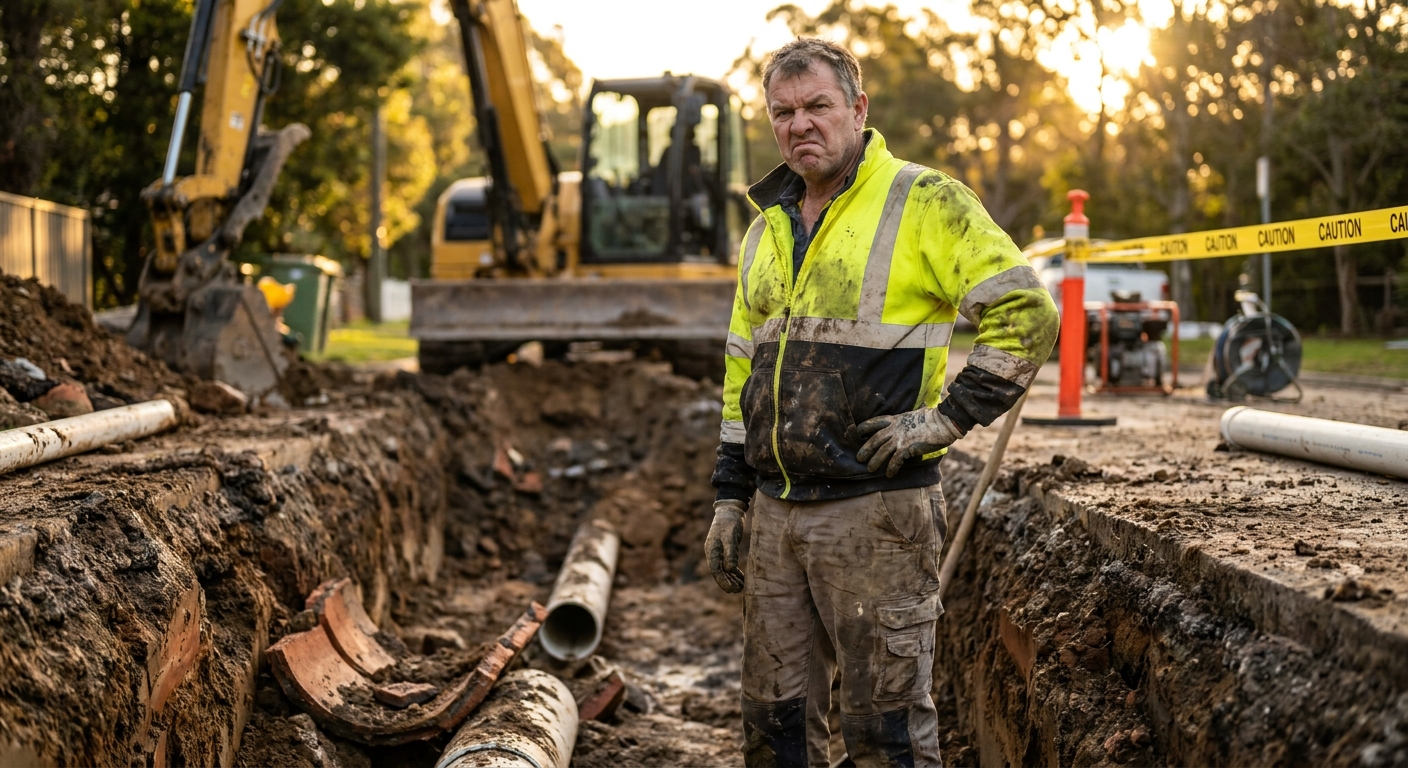
Most plumbing contractors don't have an insurance problem until the day they have a big one. Then it turns out the program has a hole in it — usually in a predictable place. We've worked dozens of plumbing fleet claims across CT, NY, and PA in the last few years, and the same handful of mistakes show up over and over. Here's what they are and how to fix them.
If you haven't read the pillar yet, start with Commercial Auto Insurance for Plumbing Contractor Fleets: The Complete 2026 Guide. This post assumes you know the structure.
Mistake #1: No Contractor's Pollution Liability
This is the big one. Standard commercial General Liability excludes pollution events — and "pollution" under most policy forms includes sewer backups, contaminated water releases, fuel-oil leaks, refrigerant releases, and mold caused by water events. For a plumber, those aren't edge cases; they're the most common severity claims in the class.
What it costs you when you don't have it: a sewer backup from a snake-and-rooter call into a customer's finished basement runs $80K–$300K. The customer's homeowners insurance pays initially, then subrogates against you. Your GL denies the claim. The check comes from your bank account.
Fix: Add a $1M/$2M Contractor's Pollution Liability policy. Cost: $2,800–$7,500/year. Best dollar-for-dollar coverage a plumber can buy. We go deep on this in our spoke Contractor's Pollution Liability for Plumbers.
Mistake #2: Underinsuring the truck-mounted jetter
A truck-mounted hydro-jetter runs $18,000–$45,000. A RIDGID SeeSnake sewer camera with monitor runs $8,000–$22,000. Together with the drain machines, pipe locators, press tools, and rolling stock, a fully-loaded plumbing service truck carries $42,000–$92,000 of equipment.
The mistake: contractors carry $25,000 in inland marine — the default limit nobody updated when the jetter was added — and then find out at claim time that the jetter alone exceeds the per-item limit.
Fix: Per-truck blanket limit of $75,000–$100,000 on jetter rigs, per-item limit of at least $25,000, replacement cost valuation, and theft-from-unattended-vehicles coverage without a special sub-limit. Annual cost increase to fix: roughly $400–$900 per truck. Worth it 100% of the time.
Mistake #3: ACV physical damage on a 2024 jetter truck
Actual cash value (ACV) physical damage pays the depreciated market value of the truck at the time of loss. For a 2024 jetter truck purchased new for $78,000 (truck + jetter + upfit), ACV at year three might settle for $52,000. Replacement of the equivalent capability in 2027? $86,000. The shortfall: $34,000.
Fix: Agreed value (or stated amount) endorsement on any truck under 4 years old or with significant upfit equipment. Premium increase: $200–$400 per truck per year. Total upside on a single total loss settlement: $5,000–$25,000.
Mistake #4: Mismatched limits between BAP, GL, and Umbrella
This is a silent killer. Your umbrella policy requires specific underlying limits — typically $1M CSL on BAP and $1M/$2M on GL. If your BAP is at $500K combined single limit, the umbrella doesn't engage until $1M of damages, leaving a $500K gap that nobody covers. Same with GL — if you bought a "starter" GL at $1M occurrence and your umbrella requires $2M, the umbrella never sees daylight.
Fix: Pull all your declarations pages today. Check the umbrella schedule of underlying. Confirm every primary policy meets or exceeds the required underlying. Bumping a $500K BAP to $1M is usually $400–$700 in premium. Bumping a $1M GL to $2M is usually $300–$500.
Mistake #5: Buying minimum limits to win the bid — and keeping them forever
You bid a $400,000 commercial job. The GC requires $1M GL minimum. You bought a $1M GL to win the contract three years ago. You're now doing $3.5M in revenue, the same $1M GL is still in force, and you're now also doing condo work and multi-tenant residential where one bad release flows into multiple units.
The mistake isn't the original purchase — it's never re-evaluating. Plumbing exposure grows linearly with revenue, but it grows exponentially when you cross into multi-tenant, hospitality, healthcare, or condo work.
Fix: Annual coverage-to-revenue review. Rule of thumb: $1M GL per $1M of revenue is a defensible floor for residential service. Add a layer for commercial and multi-tenant work. A $3M umbrella is roughly $2,200–$3,200 — small money for the catastrophic protection.
Mistake #6: Not claiming WC scheduling credit
If you have an OSHA 10/30 trained workforce, a written safety manual, confined-space procedures (sewer/manhole work), lockout-tagout, and a return-to-work program, you qualify for WC scheduling credit. Real ones — at Travelers, Liberty Mutual, and Federated Insurance — run 10–25% off the manual rate.
On a 10-truck shop with $720K of payroll at a $5.80 manual rate, that's $4,200–$10,400 in annual savings. The mistake: contractors have the safety program but never formally submit it to the underwriter, or they assume the carrier already gave them credit without confirming.
Fix: Ask your broker for a "scheduling credit narrative" at the next renewal. Provide documentation: OSHA cards, written safety manual cover page, toolbox talk logs, return-to-work form. Make the underwriter say yes or no in writing.
Mistake #7: Shopping the BAP every year while ignoring WC and CPL
Every plumbing contractor we meet wants to shop the BAP — it's the line they understand, and direct writers like Progressive Commercial make shopping easy. So they shop the BAP, save $1,800, feel like they "did insurance" for the year, and never look at the WC (where 55% of the program cost lives) or the CPL (which may not exist at all).
The math: a BAP shop might save 5–10% on the BAP line, which is itself 25% of the program. That's a 1–3% total program savings. Adding the right CPL or claiming the right WC scheduling credit can save 4–8% of the total program — twice the impact for the same broker effort.
Fix: At every renewal, ask three questions: (1) Is CPL on this program? (2) Did we claim every scheduling credit available? (3) Is the BAP competitive within the bundled package? Then shop in that order.
Bonus mistake: the captive-agent trap
If your insurance is at a captive agent — meaning the agent represents only one carrier — you're paying that carrier's rate, period. There is no shopping. There is no carrier-vs-carrier comparison. There is only "what State Farm Commercial (or Allstate Commercial, or Nationwide Captive) charges this year."
Fix: Use an independent broker who can run 4–6 markets. For plumbing fleets specifically, that means access to Travelers, Federated, Progressive, Hartford, Liberty Mutual, Berkshire GUARD, and Nationwide E&S. Single-carrier captive shops can't do this — they're not appointed.
The fix list, by priority
- Add CPL. $2,800–$7,500/year. Saves $80K–$300K on the first sewer-backup claim.
- Re-inventory the trucks and right-size inland marine. $400–$900/truck/year extra.
- Confirm umbrella underlying matches BAP + GL limits. $400–$1,200/year to fix.
- Add agreed-value endorsement on trucks under 4 years old. $200–$400/truck/year.
- Submit WC scheduling credit narrative. Free; saves $4K–$10K.
- Review GL limits vs. current revenue and customer mix. $300–$700/year to upsize.
- Move from captive to independent broker. Free; unlocks competitive shopping.
Total cost to fix all seven: usually $4,500–$11,000 in extra annual premium. Total downside if you don't fix: $300K+ on a single bad claim event.
Frequently Asked Questions
What's the single most expensive insurance mistake a plumber can make?
Skipping Contractor's Pollution Liability. Standard GL excludes sewer backups, contaminated water releases, and fuel-oil leaks. A single sewer-backup claim into a finished basement runs $80K–$300K and gets denied without CPL.
Is my truck-mounted jetter covered under commercial auto?
Partially. The jetter as physical equipment attached to the truck is covered under BAP physical damage as part of the truck's stated value (if you carry collision/comprehensive). But the jetter's hoses, nozzles, and accessory equipment, plus the sewer camera, drain machines, and hand tools inside the truck, are covered under separate inland marine, not BAP.
Do I really need an umbrella if my GL is at $2M?
Yes for any operation over 3 trucks or $1M in revenue. A $3M–$5M commercial umbrella runs $2,200–$5,500/year. One severe condo-flooding claim can hit $1.5M–$3M. The umbrella is the catastrophic backstop — and it's required for any work where the GC or owner demands $5M+ limits.
How much can I save with WC scheduling credit?
10–25% off the manual rate at Travelers, Liberty Mutual, and Federated. On a 10-truck plumbing shop with $720K payroll, that's $4,200–$10,400 in annual savings — but you have to formally document the safety program and have the underwriter approve the credit.
Is it cheaper to bundle all my insurance with one carrier?
Usually yes, by 5–10% via multiline credit at Travelers or Federated. But not always — sometimes peeling the WC out to Berkshire GUARD or moving the CPL to a specialist saves more than the multiline credit. Run both scenarios.
How often should I shop my insurance?
Re-market every 24–36 months at minimum, but review every year with your broker. Don't shop the BAP in isolation — review the full program (BAP + WC + GL + CPL + IM + Umbrella) together.
The bottom line
Most plumbing contractors aren't catastrophically underinsured — they're predictably underinsured in seven specific places. Fixing the seven mistakes above costs usually $4,500–$11,000 in extra annual premium. Leaving them in place can cost $300K+ on a single claim. The math isn't close.
Want a real audit of your current plumbing fleet program against the seven mistakes above? Contact iConn Insurance Solutions. We'll pull your declarations, walk through each line, and tell you exactly which gaps to close at the next renewal.
Contenido relacionado
AI Payment Fraud Incident Response: What to Do First
The first hour after a fraudulent wire can decide whether funds are frozen or lost. Follow this practical response guide for banks, insurers, evidence, law enforcement, and recovery.
Leer artículo →
Hotel and Commercial Property Insurance: Where Should Renewal Savings Go?
A practical guide for hotel and commercial-property owners deciding whether to keep renewal savings, lower deductibles, increase limits or restore coverage.
Leer artículo →AI Fraud Insurance Exclusions: Where Coverage Can Break
A large cyber limit can hide a small social engineering sublimit. Learn how voluntary-transfer language, verification conditions, and overlapping crime coverage can affect AI fraud claims.
Leer artículo →
Connecticut Builders Risk Insurance: 2026 Buyer’s Guide
Connecticut builders risk buyers should update project values, timelines and controls. Learn what to prepare and compare for a 2026 placement.
Leer artículo →