
What an Underwriter Actually Writes in the Margins of a Cannabis Insurance Application
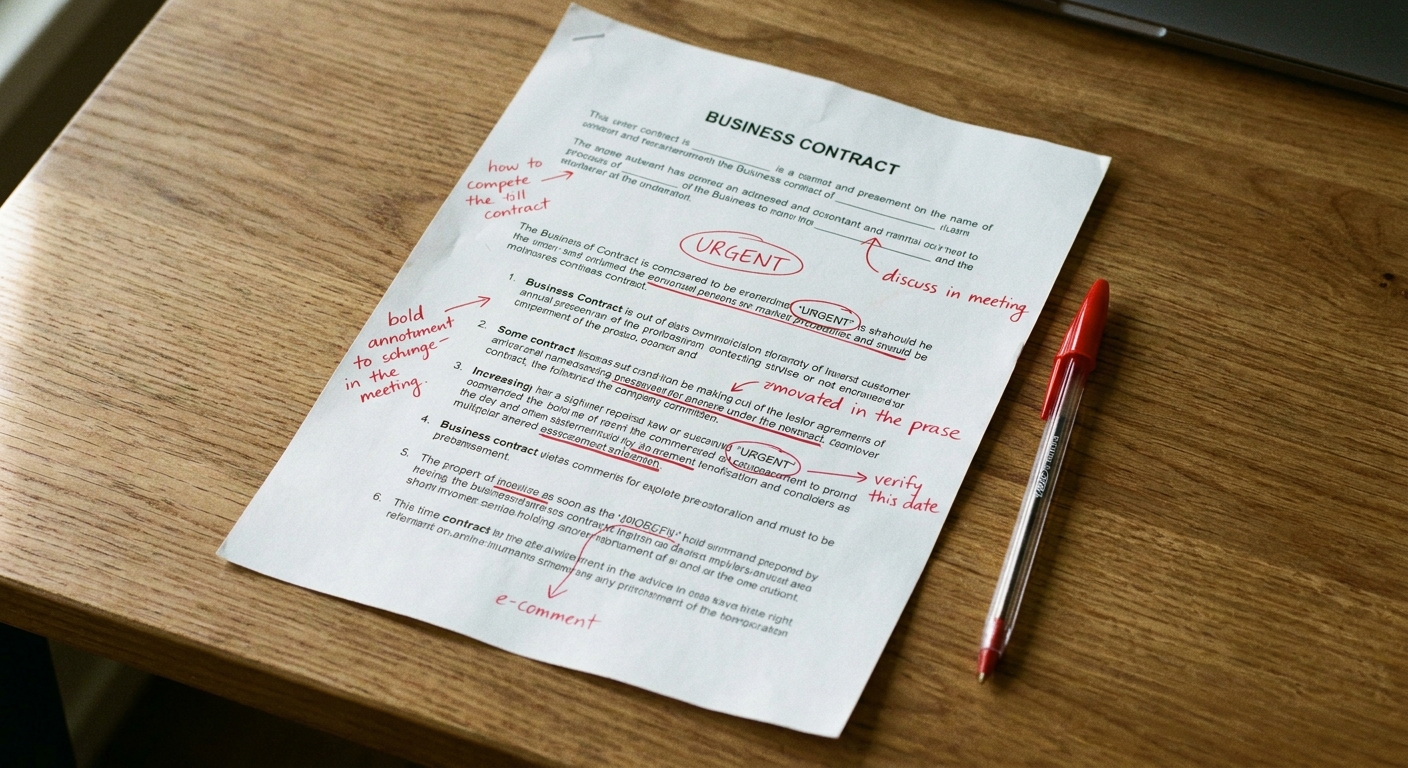
What an Underwriter Actually Writes in the Margins of a Cannabis Insurance Application
Most operators see the version of their insurance application that gets submitted: the clean, finished, broker-polished document. The version the underwriter is reading — with red-ink margin notes, circled phrases, and small marginal questions — they never see.
This post fixes that. Below is a composite annotated cannabis insurance application — a representative submission for a mid-sized Connecticut tier-2 cultivator-manufacturer, marked up the way a cannabis-experienced E&S underwriter typically marks it up. Section by section. Each margin note is translated into plain English in the green block underneath.
The goal is not to memorize the notation. It's to understand what an underwriter is thinking when they read your file — because the second you understand that, your next submission gets sharper.
The application excerpt — section by section
Greenline Cultivation & Manufacturing, LLC. Connecticut tier-2 producer license. Operating since Q4 2023. Single facility, 18,500 sq ft total — 11,200 sq ft cultivation, 4,800 sq ft manufacturing (extraction, edibles), 2,500 sq ft administrative. Annual revenue (trailing 12 months): $4.8M. 22 W-2 employees, 3 part-time contractors.
No claims in the past 5 years. Loss runs attached as Exhibit B (verified by AmTrust commercial policy, 2023–2025).
SOPs maintained as a single bound document, last revision 11/2025. Covers: cultivation protocols, pesticide application, harvest handling, extraction safety, edibles manufacturing, packaging & labeling, inventory control, security, employee training, recall procedures. Total page count: 142.

Commercial-grade alarm system (Sonitrol). 64 cameras covering 100% of cultivation, manufacturing, and limited-access areas. Surveillance recordings retained for 90 days per CT DCP requirements. Backup: on-site NVR only.
General liability: $1M / $2M. Products liability: $1M / $2M (separate aggregate). Product recall: $250K sub-limit. Property: $4.2M (building + business personal property + crop in process). Workers comp: per CT statute. Cyber: standalone $1M.
Application complete. All exhibits attached. Broker: AmTrust → Greenline transferred to specialty market 9/2025. Effective date requested: 10/01/2026.
What this composite teaches
Read the six sections together and three patterns emerge — patterns that show up in roughly every Connecticut cannabis submission we've participated in.
First: underwriters reward specificity. The Greenline composite gets a quote because every section is concrete — actual sq ft, actual revenue, actual SOP page count, actual exhibit references. Vague submissions get declined; specific submissions get conditions and counteroffers. The submissions that get fastest service are the ones that answer the next question before it's asked.
Second: most margin notes are fixable. Of the six notes in the composite above, exactly one (the surveillance redundancy) is a coverage condition — and it's a roughly $100/month cloud-backup subscription. The other five are either questions to clarify or counteroffers to negotiate. Operators sometimes treat margin notes as bad news; experienced brokers treat them as the underwriter showing their work.
Third: the application is the operator's only chance to control the narrative. Every margin note in the composite above is the underwriter filling in a gap the application didn't fill in. A stronger Section 1 would have explained the tier-2-license / tier-1-revenue dynamic up front. A stronger Section 4 would have already addressed surveillance redundancy. The strongest submissions answer the questions before the underwriter writes them.
The underwriter shorthand glossary
A small dictionary of phrases that show up repeatedly in the margins of cannabis submissions, with what they typically mean.
If you take only three things from this
- Underwriters write notes because they're engaging with your file. No notes usually means a fast decline; lots of notes usually means an interested underwriter.
- Most notes are questions, not decisions. The translation column above shows how often a red-ink scrawl is a request for clarification rather than a final answer.
- The application is the negotiation. By the time the file reaches the underwriter, the operator's leverage to control the narrative is already shrinking. Strong applications fill the gaps the underwriter would otherwise write notes into.
FAQs
Are these real margin notes?
Composite. Each note in the document reflects the kind of comment we've seen on real Connecticut cannabis submissions over the past 18 months. None is copied verbatim from any single underwriter or any single submission. The shorthand glossary at the bottom reflects general industry usage and is not specific to any one carrier.
Can my broker show me the underwriter's actual notes on my file?
Sometimes. Underwriting files are generally proprietary to the carrier, but most underwriters will discuss the substance of their notes with a broker, and a good broker will translate that into plain English for the operator. If you're bound and curious about why specific conditions or exclusions ended up on your policy, your broker can usually get the underwriter on the phone.
Does this apply only to E&S markets?
Mostly. Standard-market carriers writing through automated underwriting systems often leave fewer visible margin notes; the "notes" are coded into rating algorithms instead. Specialty E&S markets writing cannabis usually still have human underwriters making written annotations on the file. This piece reflects the specialty E&S experience.
What's the single best way to get fewer margin notes on my next submission?
Answer the questions before the underwriter writes them. A submission narrative that proactively addresses the tier/revenue dynamic, the security/surveillance approach, the SOP structure, the loss-history quality, and the requested limits with reasoning will get reviewed faster and with fewer conditions than a submission that lets the underwriter discover those issues themselves.
Sources, footnotes & further reading
- Connecticut Department of Consumer Protection — surveillance and security requirements for cannabis establishments: portal.ct.gov/DCP — Adult-Use Cannabis.
- Wholesale & Specialty Insurance Association (WSIA) — surplus-lines transaction standards: wsia.org.
- Connecticut Insurance Department — surplus-lines producer requirements: portal.ct.gov/cid.
- National Association of Insurance Commissioners (NAIC) — model surplus-lines regulation: naic.org.
Disclosures & Compliance Notes
- Composite content. The annotated application above is entirely composite. The operator ("Greenline Cultivation & Manufacturing, LLC"), the facility, the financials, the SOPs, the exhibits, and the margin notes are all illustrative. No real operator, real application, real carrier file, or real underwriter is identified or identifiable.
- Educational purpose only. This piece is general business education for Connecticut cannabis operators and their advisors. It is not legal advice, tax advice, claim advice, or a specific insurance recommendation. It is not a representation of any specific carrier's underwriting practice.
- No carrier endorsement. Any reference to a carrier name (AmTrust, Sonitrol, or any other) is descriptive — included because it's the kind of name that appears in real submissions — and is not an endorsement, a recommendation, or a representation about that company's appetite, terms, or services.
- Underwriter shorthand glossary. The glossary reflects general usage patterns across multiple carriers and markets. Specific carriers may use different terminology or apply different meanings to similar phrases. Always confirm interpretation with your broker.
- Coverage outcomes vary. Nothing in this article is a guarantee that a similar submission, similar margin notes, or a similar set of conditions will produce a similar quote in your situation. Underwriting outcomes depend on the specific facts, carrier, market conditions, and submission quality.
- Regulatory citations. Connecticut DCP, CID, and federal references reflect rules in effect at the time of writing. Cannabis regulation evolves; verify current rules with the relevant agency.
- Licensing. iConn Insurance Solutions is a licensed Connecticut insurance producer. License details available via the Connecticut Insurance Department.
- Last reviewed. July 28, 2026.
Contenido relacionado
AI Payment Fraud Incident Response: What to Do First
The first hour after a fraudulent wire can decide whether funds are frozen or lost. Follow this practical response guide for banks, insurers, evidence, law enforcement, and recovery.
Leer artículo →
Hotel and Commercial Property Insurance: Where Should Renewal Savings Go?
A practical guide for hotel and commercial-property owners deciding whether to keep renewal savings, lower deductibles, increase limits or restore coverage.
Leer artículo →AI Fraud Insurance Exclusions: Where Coverage Can Break
A large cyber limit can hide a small social engineering sublimit. Learn how voluntary-transfer language, verification conditions, and overlapping crime coverage can affect AI fraud claims.
Leer artículo →
Connecticut Builders Risk Insurance: 2026 Buyer’s Guide
Connecticut builders risk buyers should update project values, timelines and controls. Learn what to prepare and compare for a 2026 placement.
Leer artículo →