
Workers' Comp for CT Contractors & Trades: The Subcontractor Pitfalls That Destroy Profit
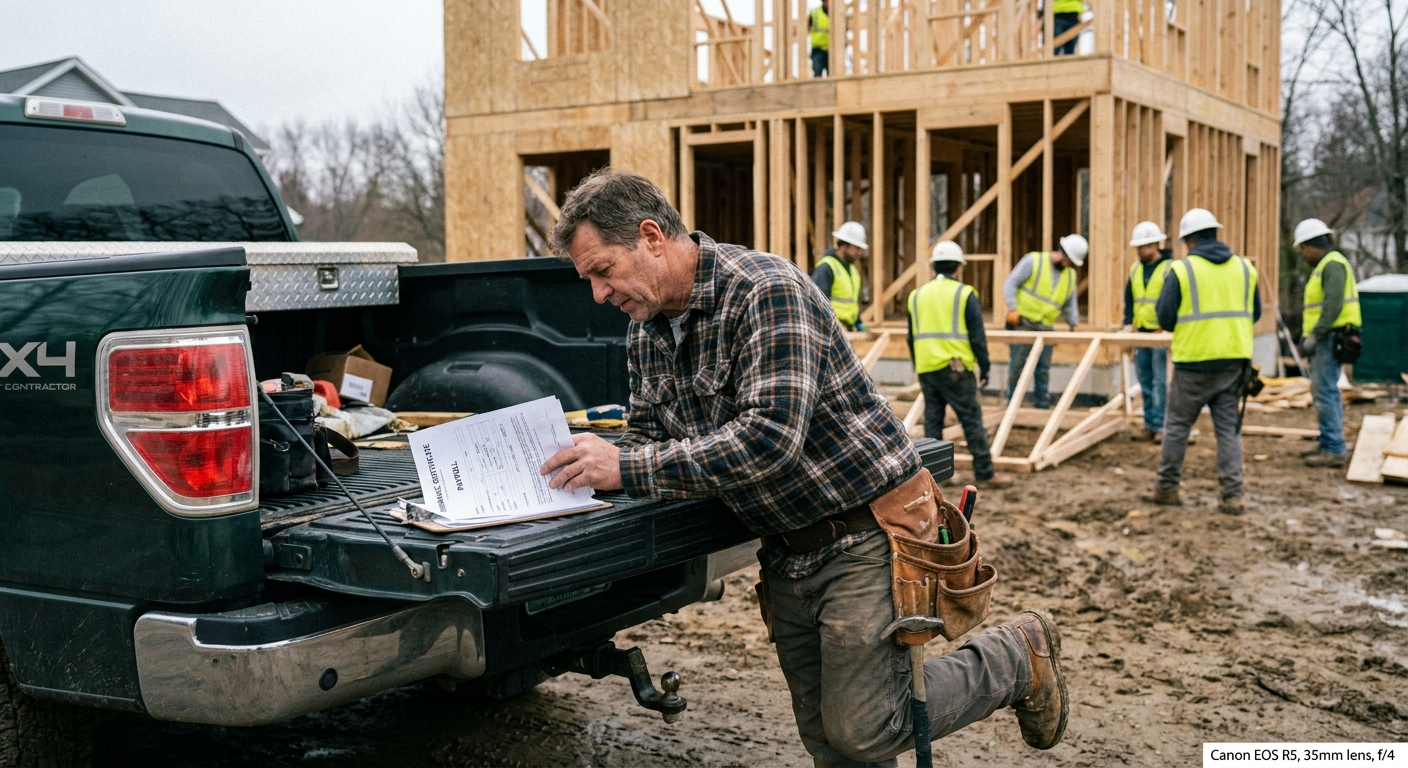
Quick answer: Connecticut contractors and trades businesses get burned at their workers' comp audit when 1099 subcontractors lack proof of their own workers' comp coverage. Any sub without a current certificate of insurance (COI) on file at audit time rolls onto your policy at your highest payroll-weighted class code — usually generating an audit bill of $5,000–$40,000+. The fix is a documented COI collection process, a five-step onboarding workflow, and disciplined classification practices. This guide walks through all three.
If you run a CT contracting business of any size — general contractor, electrical, plumbing, HVAC, roofing, landscaping, painting, drywall, masonry — the audit bill from your workers' comp carrier is the biggest unforced error in your insurance program. Almost every CT contractor we meet has either eaten one or is one renewal away from eating one.
The cause is almost never the contractor's own employees. It is the subcontractors. In Connecticut, the workers' comp rule is unforgiving: if you cannot prove at audit that every sub on the job had their own workers' comp policy in force on every day they worked for you, that sub's payroll gets added to yours. At the auditor's discretion, the entire 1099 payment to that sub becomes covered payroll, multiplied by your highest applicable class-code rate. The bills routinely hit $10,000–$40,000 for businesses that thought they were doing things right.
This guide is the operational fix. You will get the COI collection system that actually works in the field, the five-step subcontractor onboarding workflow, the CT-specific independent contractor vs. employee analysis, the most common classification mistakes specific to trades, and a real Hartford-area HVAC case study where this exact problem cost the owner $28,000 in a single audit.
Why CT Contractors Get Hit Hardest at Audit
Two structural facts about the Connecticut workers' comp market combine to make contractors especially vulnerable at audit time.
First, the class codes for trades are expensive. A general office class code might be $0.30 per $100 of payroll. Roofing (class code 5551) in CT runs $20–$35 per $100 of payroll. Carpentry (5403), excavation (6217), and electrical (5190) all sit in the $4–$12 range. When uncovered sub payroll gets added to your audit, it is being added at those rates — not at your average rate.
Second, CT auditors apply the highest applicable class code if classification is unclear. If a sub framed a wall and shingled the roof, an auditor with no other documentation will assign the roofing rate to all of that sub's payroll — not just the roofing portion. That is how a $30,000 paid-out 1099 becomes an audit charge of $9,000 instead of $1,500.
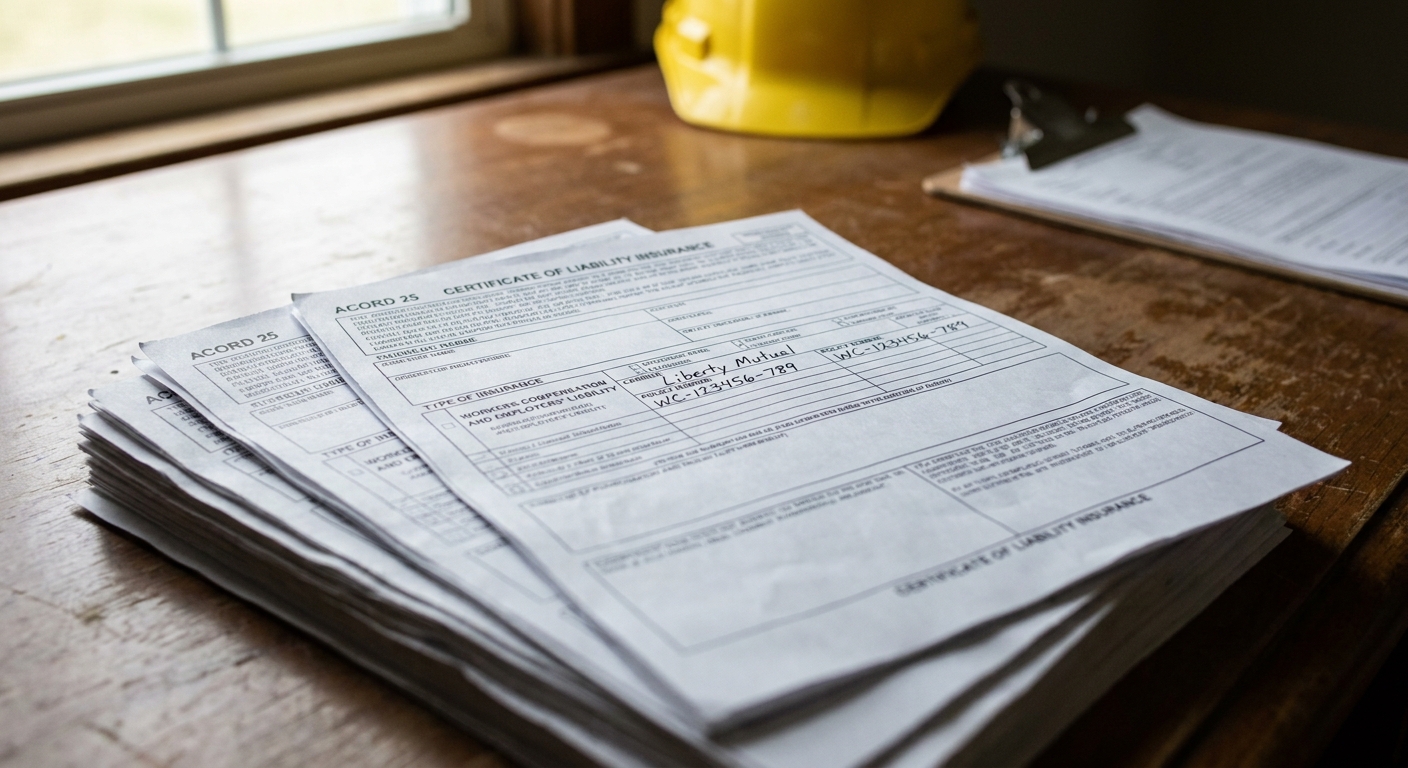
The math is brutal. Consider a CT roofing contractor who paid four subs a combined $80,000 over the year and assumed all four were properly covered:
| Scenario | Sub COIs On File | Audit Calculation | Extra Premium Due |
|---|---|---|---|
| All 4 subs documented | 4 of 4 | $0 added payroll | $0 |
| 1 sub missing COI | 3 of 4 | $20K added at roofing rate ($25/$100) | $5,000 |
| All 4 missing COIs | 0 of 4 | $80K added at roofing rate | $20,000 |
That is not the bill from the carrier — that is the extra bill, on top of what the contractor already paid for premium. Every missing COI is a roughly $5,000 mistake at audit, and they compound.
The COI Collection System That Actually Works
The problem is not that CT contractors do not know they need COIs. They know. The problem is that COI collection is treated as a one-time event at the start of the job, when it needs to be treated as a recurring annual event tied to the sub's policy period, not the job period.
A working COI system has four moving parts:
The 4-Part CT Contractor COI System
- A single source of truth. One folder (digital or physical) for current COIs — not buried in project folders. A shared Google Drive folder or COI tracking software like JDi Data or myCOI works equally well.
- An expiration calendar. Each COI has a policy expiration date. The day a COI expires, that sub is uncovered as far as your audit is concerned. The calendar fires a renewal request 30 days before each expiration.
- A no-pay-without-COI rule. Accounts payable does not cut a check to a 1099 sub unless a current, valid COI is on file. This is the single most powerful control. Subs find their COIs fast when their next check depends on it.
- Direct carrier verification. Subs occasionally provide expired or counterfeit COIs. Once a year, the office calls the listed carrier on a sample of sub COIs to verify the policy was actually in force. The CT Insurance Department lookup is also a free verification tool.
A COI must show: the sub's legal name, the carrier name, the policy number, the effective and expiration dates, and the workers' comp coverage line specifically (not just general liability). Your company should be named in the "certificate holder" box, and ideally noted as an "additional insured" on general liability — though for workers' comp purposes, what matters is the policy existence and dates.
Pro tip: The most expensive COI gap is the renewal gap. A sub had coverage in January, the policy lapsed in March, they kept working through June, and you assumed everything was fine because you have a COI on file. That COI shows policy dates that expired in March. The auditor catches it instantly. Track expiration dates, not just existence.
The 5-Step Subcontractor Onboarding Workflow
The COI system above only works if you never allow a sub onto a job site before they have been formally onboarded. Here is the five-step workflow that successful CT trades businesses use:
- Pre-engagement vendor packet. Before any work starts: W-9, signed subcontractor agreement, COI for workers' comp, COI for general liability (and auto if they drive on company business), and (for CT contractors) a copy of their CT trade license if applicable. No exceptions, no verbal commitments.
- COI verification. The office logs the COI in the tracking folder, records the expiration date in the calendar, and sets the 30-day renewal reminder. The sub is added to the active vendor list only after this step is complete.
- Scope-of-work documentation. The signed agreement should describe the trade and work the sub performs. If the sub does multiple trades, list them separately. This documentation defends against worst-rate classification at audit.
- Job-site verification. Foreman or PM confirms the sub on site matches the sub on the paperwork. (Crews change. The sub you signed up may not be the crew that shows up next month.) Day labor — cash-paid workers who appear on a single job site — is automatically treated as your employee by CT auditors. There is no exception.
- Renewal cycle. 30 days before COI expiration: request renewal. 15 days before: second request, AP flagged. 0 days: AP holds payment, sub gets a call. Always before audit time: a fresh sweep to confirm every active sub has current COIs through their last working day for you.
The Independent Contractor vs. Employee Trap in Connecticut
Even a perfect COI cannot save you if Connecticut classifies your "sub" as an employee. CT uses the ABC test for workers' comp coverage status, which is one of the strictest in the country. To treat a worker as an independent contractor (and thus not require them to be on your workers' comp policy), all three of these must be true:
- A — Autonomy: The worker is free from your direction and control in the performance of the work, both under the contract and in fact.
- B — Business: The work is performed outside the usual course of your business, OR outside your usual places of business.
- C — Customarily engaged: The worker is customarily engaged in an independently established trade, occupation, profession, or business of the same nature as the work being performed.
The trap for CT contractors is prong B. If you are a roofing company and you hire a "1099 roofer" to perform roofing work on a job you contracted — that fails prong B. Roofing is the usual course of your business. CT will reclassify that "sub" as an employee for workers' comp purposes regardless of what your 1099 form says.
The legitimate version: you hire a separate roofing company (owners and crew) to perform a specific roofing job, they bring their own equipment, schedule their own crew, set their own pricing, have their own workers' comp policy, and are an established business serving other customers. That sub passes the ABC test.
The shorthand: real subs are other companies you contract with. They are not "1099 employees" wearing a different label. CT auditors and the state Department of Labor both apply this test aggressively, and misclassification triggers back-premium, penalties, and possible labor-law liability.

The Classification Mistakes That Sink CT Contractors
Classification — choosing the right NCCI class codes for your workforce — is the other half of the contractor audit problem. We covered the broader topic in our CT class codes guide, but trades businesses face a few specific traps worth calling out:
1. Office Payroll Lumped Into the Trade Code
If your office manager or estimator sits at a desk all day, they belong in class code 8810 (clerical), which runs about $0.30 per $100. If their payroll is reported under the company's roofing or carpentry code, you are overpaying by a factor of 30–100. Annual review of who is coded under what is the simplest premium cut available to most CT contractors.
2. Owner Payroll Without an Election
CT corporate officers and LLC members can elect inclusion in or exclusion from workers' comp coverage. Exclusion saves the premium on their payroll. Inclusion provides coverage if they get hurt on the job. The decision depends on the owner's other health and disability coverage. If no election form is on file with the carrier, the default treatment varies and audit gets messy. Make the election explicit.
3. Multi-Trade Crews Reported Under One Code
A landscaper who also does small construction projects has two different classifications available. Reporting all payroll under one code instead of splitting by actual hours worked under each trade is a common overpayment trap. CT carriers allow split reporting when supported by time records.
4. Permanent Helpers Treated as Day Labor
Cash-paid "helpers" who show up on multiple jobs over months are not casual labor in CT — they are unreported employees. The audit captures them through job-site records, payment records, or worker interviews. Penalties for unreported payroll can equal or exceed the back-premium itself.
A Hartford HVAC Company Case Study: $28,000 Audit Bill
Names changed, story real. A Hartford-area HVAC company with 12 employees and an annual workers' comp premium of $41,000 came to iConn in late 2024 after a brutal audit. The audit bill was $28,000 on top of the premium they had already paid.
Where the $28,000 came from:
- $11,400 from three 1099 install subs whose COIs had expired during the policy period (no renewal calendar in place).
- $8,200 from a fourth sub who was reclassified as an employee under the ABC test (he worked exclusively for them for 8 months, used their truck, followed their schedule).
- $5,800 from misclassified office payroll — their bookkeeper had been coded under the HVAC field rate for three years.
- $2,600 in audit-related penalties and processing fees.
We disputed the audit. The class-code error on the bookkeeper was reversed cleanly — documented job description, desk-based work, no field exposure. The two expired-COI subs whose policies could be retroactively verified through their carriers were credited back. We could not save them on the reclassified sub or the third expired-COI sub. Net audit bill after dispute: $14,300. Still a six-figure mistake over the lifetime of the operation, but cut roughly in half.
The next year, with COI tracking software in place, the no-pay-without-COI rule enforced in accounts payable, and the ABC test applied to every new sub engagement, the audit added zero dollars. The systems do work. They just need to be in place before the audit, not after.
What to Take Into Your Next Audit
A CT contractor walking into an annual workers' comp audit should be carrying:
- Current and prior-year COIs for every 1099 sub paid during the audit period, with policy effective and expiration dates that cover the work performed.
- Signed subcontractor agreements for each sub describing scope and trade.
- Payroll register split by class code, with job descriptions supporting each classification.
- Owner / officer exclusion or inclusion forms on file with the carrier.
- Time records supporting split classifications for any employees working under multiple class codes.
- Overtime records (overtime premium pay is excluded from workers' comp payroll calculations in CT — many auditors will not back this out unless asked).
The full audit prep checklist and what to expect on audit day is laid out in our CT workers' comp audit survival guide.
Frequently Asked Questions: CT Contractor Workers' Comp
Do I need workers' comp in Connecticut if I only have 1099 subs and no employees?
If you have zero W-2 employees and all the workers on your job sites pass CT's ABC test as true independent contractors with their own workers' comp policies, you may not be required to carry a policy yourself. But the moment one sub fails the ABC test or works without coverage, you are exposed to both audit-style assessments from any carrier you do business with and to direct CT statutory penalties. Most CT contractors carry a minimum-premium workers' comp policy even with no employees, both to maintain a relationship with a carrier and to protect against misclassification surprises.
If a sub gets hurt on my job site and has no workers' comp, what happens?
Under CT law, if the sub had no coverage of their own, the general contractor's policy is on the hook for the injury. The carrier will pay the claim, then audit you for the premium that should have been charged on that exposure, plus penalties. If you also had no policy, the liability falls on you personally and on your business. The CT Workers' Compensation Commission will issue assessments that can be filed as judgments against the business and (in some cases) personal assets.
Are sole proprietors required to have workers' comp on themselves in CT?
Sole proprietors and partners are generally not required to carry workers' comp on themselves under CT law, but they may elect coverage. Most CT general contractors require any sub coming on their site — including sole-prop subs — to either carry workers' comp on themselves or sign a waiver. Even then, if the sole prop is reclassified as your employee under the ABC test at audit, the waiver does not protect you from the back-premium assessment.
What is a "ghost policy" and should I accept one from a sub?
A ghost policy (sometimes called a "minimum premium" policy) is a workers' comp policy issued to a sole proprietor with no employees, providing no coverage to the owner but allowing them to provide a COI to general contractors. Whether to accept one is a judgment call: it satisfies the contract documentation, but it provides no real protection if that sub gets hurt on your job. If the sub then fails the ABC test, you still owe back-premium. Many CT GCs require either a real policy with elected coverage or a signed liability waiver, not just a ghost policy COI.
How far back can a CT workers' comp auditor go on uncovered subs?
A standard annual audit covers the most recent policy period (12 months). But carriers have the right to reopen prior audits for up to three years if they discover material misstatement — including newly discovered uncovered subs. Practically, most adjustments come from the current period, but be aware that bad sub records from years past are not automatically beyond reach.
Will my workers' comp premium go up just because I use subs?
Not on the premium itself — subs with valid COIs cost you nothing on your workers' comp policy. But carriers often charge a higher minimum premium and ask for tighter documentation if a contractor's payroll-to-sub ratio is heavily sub-weighted. Some carriers will decline contractors who do 80%+ of revenue through subs because the audit exposure is too volatile. A broker who understands the CT trades market can place these accounts; captive agents often cannot.
Run a CT Trades Business? Let's Audit-Proof Your Subs.
We help CT contractors design COI tracking systems, set up the AP-side enforcement, run the ABC-test analysis on every sub engagement, and walk into the annual audit with a binder that auditors hate to dig into. No charge for the review — we earn our keep at renewal.
Request a CT contractor workers' comp review →This guide is part of our complete coverage of workers' comp for CT businesses. Start with the 2026 guide to CT workers' compensation insurance for the overview. Drill into class codes and experience modifiers for the formula mechanics. Prepare for the annual workers' comp audit. And build a return-to-work program for the long-run e-mod savings that compound year after year.
iConn Insurance Solutions and our sister agency Insure Connecticut LLC place CT contractor workers' comp through The Hartford, Travelers, AmTrust, Liberty Mutual, EMC, Berkshire Hathaway GUARD, and the CT-specific contractor markets. Trades businesses are a specialty; we know which carriers will write your class code, your sub ratio, and your experience — and which ones will decline you.
Contenido relacionado
AI Payment Fraud Incident Response: What to Do First
The first hour after a fraudulent wire can decide whether funds are frozen or lost. Follow this practical response guide for banks, insurers, evidence, law enforcement, and recovery.
Leer artículo →
Hotel and Commercial Property Insurance: Where Should Renewal Savings Go?
A practical guide for hotel and commercial-property owners deciding whether to keep renewal savings, lower deductibles, increase limits or restore coverage.
Leer artículo →AI Fraud Insurance Exclusions: Where Coverage Can Break
A large cyber limit can hide a small social engineering sublimit. Learn how voluntary-transfer language, verification conditions, and overlapping crime coverage can affect AI fraud claims.
Leer artículo →
Connecticut Builders Risk Insurance: 2026 Buyer’s Guide
Connecticut builders risk buyers should update project values, timelines and controls. Learn what to prepare and compare for a 2026 placement.
Leer artículo →