
Deepfake, Quishing & Smishing: 2026 Cyber Attack Variants & Coverage Gaps for CT Mid-Market
The CFO of a Hartford manufacturer got a video call from the company's longtime parts supplier in Germany — face-to-face, voice matching the supplier's actual European accent, asking to update bank routing details before that afternoon's $340,000 wire. The CFO updated the details. The wire cleared at 4:11 PM. The next morning, the real supplier called asking about their unpaid invoice. The video call had been an AI deepfake assembled from the supplier executive's LinkedIn videos and earnings-call recordings. The carrier denied the social engineering claim because the company's policy required out-of-band voice verification on a known phone number — and the CFO had relied on what looked like out-of-band video verification instead.
This is the third spoke in our CT Cyber Insurance for Mid-Market cluster, following the pillar guide and the Social Engineering & Wire Fraud spoke. Where the prior post covered traditional BEC and vendor invoice manipulation, this piece dives into the three attack variants that emerged in 2024–2025 and are now driving the bulk of mid-market losses: deepfake video/audio, QR code phishing (quishing), and SMS-based smishing attacks.
What are the emerging social engineering variants targeting CT mid-market firms?
Three social engineering variants now drive the majority of new CT mid-market losses: (1) deepfake voice/video impersonation of executives or vendors in synchronous calls, (2) QR code phishing (quishing) in emails and printed material that redirects to credential-harvesting sites, and (3) SMS smishing targeting mobile devices with company-branded urgency. Each variant exploits a different gap in legacy authentication controls — and cyber policies' "out-of-band verification" language often hasn't caught up. CT mid-market firms should verify their policy specifies verification on a KNOWN PHONE NUMBER, not "any out-of-band channel."
The FBI Internet Crime Complaint Center (IC3) and CISA have both flagged deepfake and quishing attacks as the fastest-growing social engineering categories. The Hong Kong arm of UK firm Arup lost $25M in February 2024 to a deepfake video call impersonating the CFO — and that was just the first widely publicized case. Mid-market CT firms aren't immune; they're often more vulnerable because their authentication procedures haven't been stress-tested against synchronous AI-generated impersonation.
At iConn Insurance Solutions, we're seeing the policy-language gap widen in real time. Carriers wrote 2022 and 2023 policies with "out-of-band verification" requirements assuming the only out-of-band channel was a phone call. In 2026, attackers route synchronous video calls and SMS messages to compromised channels — and policy claims adjusters are arguing that compromised "out-of-band" channels don't satisfy the policy condition. The result: technically reasonable employees following policy procedures get denied coverage on losses.
Variant 1: Deepfake video and audio impersonation
The technology curve for synthetic voice and video has collapsed in 18 months. Voice cloning that required 30+ minutes of source audio in 2023 now works on 3–5 seconds of source material. Real-time video deepfaking on consumer hardware became viable in early 2025. Both are now used in attacks against mid-market firms.
Attack pattern
Attackers collect source material from public sources (LinkedIn videos, earnings calls, podcast appearances, conference keynotes). They generate a synthetic voice or video that matches the target executive or vendor contact. They initiate a synchronous call to a wire-authorizing employee — often timed during the executive's known travel — and request an urgent transfer or banking detail update.
What the policy actually requires
Most cyber policies (and standalone crime policies) require "out-of-band verification" for transfer instructions. Originally, this meant a phone call to a known number — separate from the email or messaging channel where the request originated. The policy language often doesn't specify which out-of-band channel. Carriers now argue that if the verification happened on a video call (the deepfake channel), the verification was technically in-band — voiding coverage.
Defense
Update your wire authentication procedure to require verification on a KNOWN PHONE NUMBER (not video, not text, not a number provided in any communication tied to the request). For executive transfers, add a code-word protocol — a pre-agreed phrase the executive uses to confirm authenticity that no attacker can know from public sources.
Variant 2: QR code phishing (quishing)
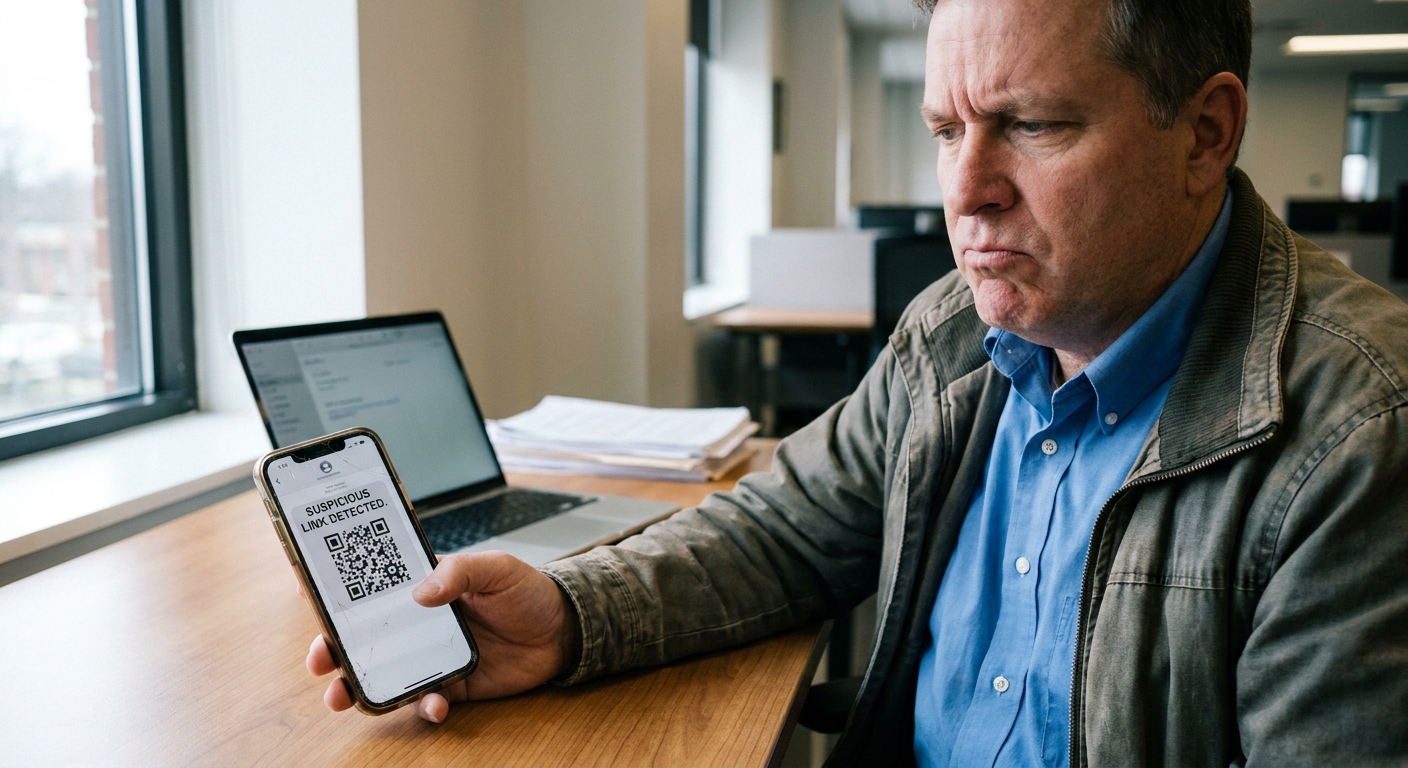
QR codes bypass most enterprise email security because they're images, not URLs. Email gateways scan links; QR codes embed the URL inside an image that's only resolved when the recipient scans it with a phone. The phone — outside the corporate network and security perimeter — then visits the malicious site.
Attack pattern
Attackers send an email that looks like an authentication challenge, a delivery notification, a parking ticket, a tax form, or a Microsoft 365 password reset. The email contains a QR code with instructions to scan it. The user scans on their personal phone, lands on a credential-harvesting page that looks identical to Office 365 or the company's SSO portal, and enters credentials. Attacker now has account access.
What the policy actually covers
Credential theft via quishing typically falls under the cyber policy's standard incident response and breach coverage — NOT under social engineering sublimits, because no voluntary transfer of funds occurred. But the downstream losses (BEC initiated from the compromised account, ransomware deployed via stolen credentials) flow into other policy sections with their own sublimits.
Defense
Block QR codes in email at the gateway level where possible. Train employees never to scan QR codes from email on personal devices. Roll out FIDO2 phishing-resistant authentication (YubiKeys, passkeys) so stolen credentials alone don't grant access. Most carriers now offer 10–15% premium credits for documented FIDO2 deployment.
Variant 3: SMS smishing on corporate mobile devices
Smishing attacks have evolved from generic "your package can't be delivered" texts to targeted company-branded urgency. Attackers compromise an employee directory (often via prior LinkedIn or breach data), send SMS messages spoofing the CEO or IT department, and direct the target to a credential page or a phone call.
Attack pattern
"This is Sarah from IT — we're locking down accounts after a security incident, please confirm your credentials at [link]" or "It's Mike, your CEO — I need you to handle something urgent, call me at this number." The link or number is attacker-controlled.
What the policy covers
Same gap as deepfake — if the employee voluntarily parts with credentials or funds after SMS-based deception, the carrier looks at whether the policy's verification conditions were met. SMS is almost never a sufficient verification channel under standard policy language; using it instead of a phone call usually voids coverage.
Defense
Mobile device management (MDM) with SMS filtering on corporate devices. Train employees that IT and the CEO will NEVER request credentials or wire approvals via SMS. Verify any unusual request by walking to the requester's office or calling their known desk number.
How to verify your cyber policy actually covers these variants
Before binding or renewing your cyber program, ask the broker to walk you through these specific policy provisions:
- Out-of-band verification language: Does the policy require a KNOWN PHONE NUMBER specifically, or any "out-of-band channel"? The former is much narrower and safer.
- Deepfake / synthetic media exclusion: Some 2025+ policies are starting to add specific deepfake exclusions. Don't accept one.
- Voluntary parting vs. computer fraud: How does the policy distinguish? Quishing-led credential theft followed by attacker-initiated wires might be voluntary parting (low sublimit) or computer fraud (higher sublimit).
- FIDO2 / hardware key credit: Most modern carriers (Coalition, At-Bay, Resilience, Beazley) give 10–15% credits for documented phishing-resistant authentication. Ask.
- Wire authorization training documentation: Required for many policies to qualify for $500K+ social engineering sublimits.
This is exactly the granular policy review that an independent broker provides. Get a cyber policy gap audit from iConn Insurance Solutions — we'll map your current policy language against the emerging attack variants and identify the specific gaps before a claim does.
The financial planning side: building reserves for uncovered cyber losses
Even the best cyber program leaves gaps — the social engineering sublimit, the deductible, the conditional coverage. CT mid-market firms increasingly pair insurance with treasury reserves sized to absorb a worst-case fraud event. Our colleagues at Wealth America handle that planning — sizing emergency reserves, structuring buffer lines of credit, and stress-testing the business's ability to weather a six- or seven-figure uncovered loss. Insurance pays the covered piece; treasury planning covers the gap.
Why independent brokers matter for cyber policy language analysis
The fastest-evolving area in cyber insurance right now isn't pricing — it's policy language. Carriers add exclusions, narrow conditions, and shift sublimits between renewal periods, often without highlighting the changes. An independent broker reading the policy form word-for-word and comparing across appointed carriers is the only way to know what you're actually buying. Captive agents at a single carrier can't perform that comparison.
Our sister agency Insure Connecticut LLC writes cyber for mid-market firms across 12 states — same independent multi-carrier approach with broader regional reach for multi-state operators.
Key takeaways
- Three emerging social engineering variants now drive most new CT mid-market losses: deepfake video/audio, QR code phishing (quishing), and SMS smishing.
- Voice cloning works on 3–5 seconds of source audio; real-time video deepfaking became viable in early 2025.
- Policy "out-of-band verification" language often doesn't specify channel — push for "known phone number" specifically.
- FIDO2 hardware-key authentication earns 10–15% premium credits with modern cyber carriers.
- Pair cyber insurance with treasury reserves sized to absorb the uncovered gap on a worst-case fraud event.
Frequently Asked Questions About Deepfake & Emerging Social Engineering Coverage
Do cyber insurance policies cover deepfake voice or video attacks?
Cyber policies generally cover deepfake-driven losses under the social engineering or fraudulent instruction section — but ONLY if the policy's verification conditions were met. If the verification happened on the compromised channel (e.g., the deepfake video call), the carrier often argues verification was "in-band" and voids coverage. Push for "known phone number" verification language.
What is QR code phishing (quishing) and how does insurance respond?
Quishing embeds malicious URLs in QR code images that bypass email security scanning. Credential theft via quishing typically falls under standard cyber breach coverage. Downstream losses (BEC, ransomware deployed via stolen credentials) flow into separate policy sections with their own sublimits — making the total claim split across multiple coverage parts.
Are SMS smishing attacks covered under cyber insurance?
Sometimes — but SMS is almost never a sufficient "out-of-band verification" channel under standard policy language. If the employee verified an instruction via SMS (instead of a known phone number), the carrier typically voids coverage. Train employees that SMS is never an authoritative verification channel for wires or credential requests.
What's the cheapest way to reduce my cyber premium against these attack types?
FIDO2 phishing-resistant authentication (YubiKeys, passkeys) earns 10–15% premium credits with most modern cyber carriers (Coalition, At-Bay, Resilience, Beazley). Documented annual phishing simulation training adds another 5%. Combined cost is typically $100–$200 per employee — paid back via premium credits within 2–3 years.
Is there a specific deepfake exclusion in cyber policies?
Some 2025+ cyber policies have begun adding specific synthetic-media or deepfake exclusions. Don't accept one without negotiating. Push the broker to confirm the policy form covers losses arising from any social engineering technique — without carving out the emerging variants.
How much should a CT mid-market firm budget for cyber reserves on top of insurance?
A common heuristic is to size reserves at the gap between your largest plausible loss and your cyber policy's social engineering sublimit. For a firm wiring $500K+ regularly with a $250K sublimit, $250K–$500K in dedicated reserves (or a committed line of credit) covers the realistic gap. The treasury and financial planning side is best handled with a wealth advisor.
Get your cyber policy audited against the 2026 attack variants
Request a cyber policy gap audit from iConn Insurance Solutions — we'll review your current policy language, identify the specific gaps against deepfake/quishing/smishing attack patterns, and shop alternatives across 10+ appointed cyber markets. Multi-state operators can also tap our sister agency Insure Connecticut LLC for 12-state coverage.
For the treasury and reserve-planning side of fraud risk, our colleagues at Wealth America structure the liquidity strategy that complements the insurance program.
Insure Connecticut LLC, iConn Insurance Solutions, and Wealth America, Inc. are independently operated companies under common ownership.
Related Content
AI Payment Fraud Incident Response: What to Do First
The first hour after a fraudulent wire can decide whether funds are frozen or lost. Follow this practical response guide for banks, insurers, evidence, law enforcement, and recovery.
Read post →
Hotel and Commercial Property Insurance: Where Should Renewal Savings Go?
A practical guide for hotel and commercial-property owners deciding whether to keep renewal savings, lower deductibles, increase limits or restore coverage.
Read post →AI Fraud Insurance Exclusions: Where Coverage Can Break
A large cyber limit can hide a small social engineering sublimit. Learn how voluntary-transfer language, verification conditions, and overlapping crime coverage can affect AI fraud claims.
Read post →
Connecticut Builders Risk Insurance: 2026 Buyer’s Guide
Connecticut builders risk buyers should update project values, timelines and controls. Learn what to prepare and compare for a 2026 placement.
Read post →