
Workers Comp for CT Film Crews 2026: Class Codes, E-Mods & Premium Control
Connecticut film and television production crews work in conditions most office workers will never see — rigging 80-pound lighting fixtures 25 feet in the air, lifting dolly track on six-hour overnight shoots, and operating Steadicam rigs that weigh more than a toddler. Workers' compensation insurance isn't a "nice to have" line item; it's the legal mechanism that keeps a production from being financially destroyed when a grip falls off a ladder at 2 AM in Stamford.
And here's what most first-time producers don't realize: Connecticut workers' comp class codes for film crews carry some of the highest rates in the entire state code book. A general office worker (class code 8810) costs about $0.25 per $100 of payroll. A film grip (class code 9610) can run $8-$12 per $100 of payroll — a 32-48x multiple. Get the classification wrong, and you're either dramatically underpaying for coverage (and risking a back-billed audit that wipes out your margin) or massively overpaying because someone classified your office PA as a stunt coordinator.
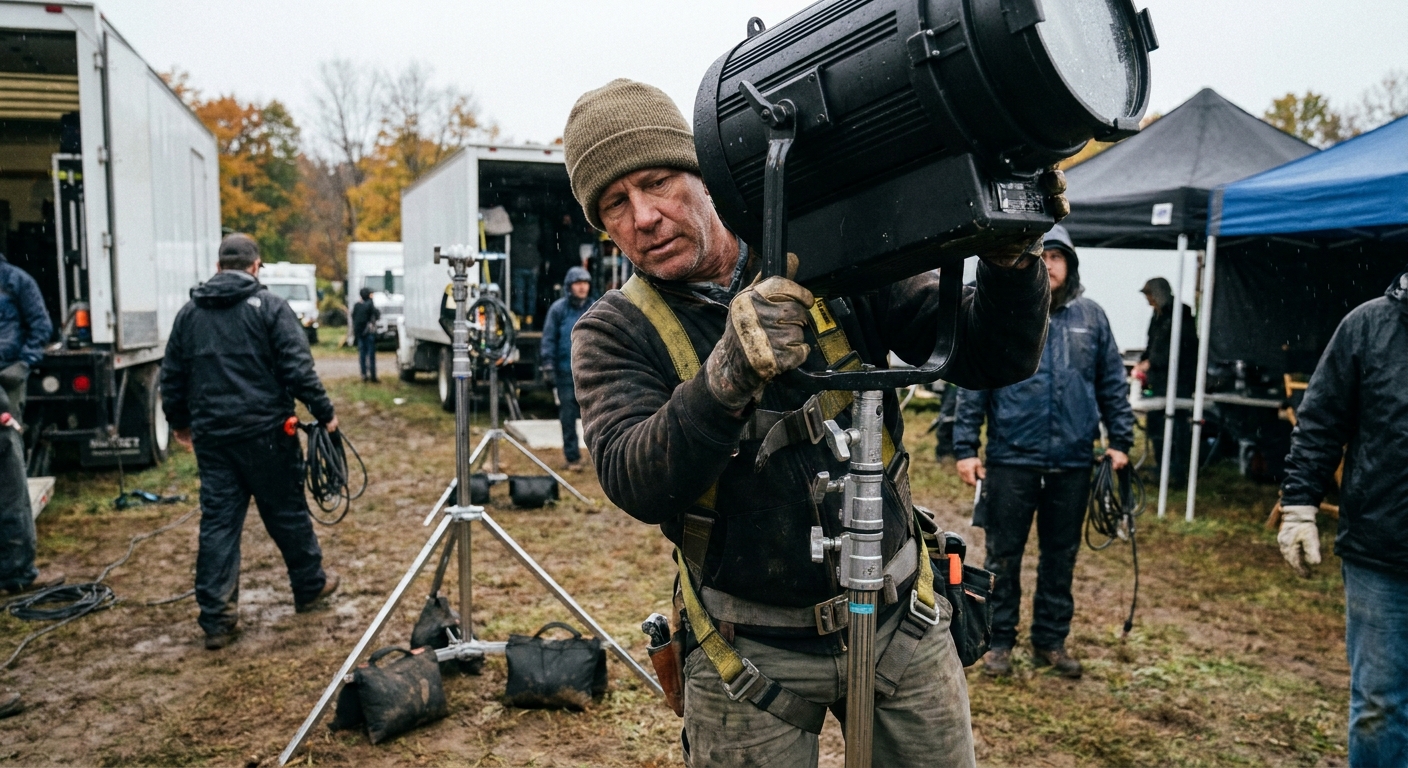
CT grip operating C-stand with sandbag rigging — proper safety gear matters for workers' comp claims defense.
How Much Does Workers' Comp Cost for Connecticut Film Productions?
Workers' compensation in Connecticut is mandatory the moment you have a single employee — and the Connecticut Workers' Compensation Commission (wcc.state.ct.us) takes uninsured-employer enforcement seriously. Penalties for operating without coverage can include criminal charges for the producer, daily fines, and personal liability for any injury that occurs. Even if every crew member you hire is an "independent contractor" on paper, CT applies a strict "ABC test" — and most production roles fail it. The grip working under your DP, taking direction from your production schedule, using your equipment? They're an employee for workers' comp purposes, contractor agreement notwithstanding.
Connecticut Workers' Comp Class Codes That Apply to Film Productions
Most CT productions touch four to seven different NCCI class codes. Misclassifying payroll across these codes is the #1 source of audit surprises — both the kind where you owe more, and the kind where you've been overpaying for two years and didn't realize it.
| Class Code | Description | 2026 CT Rate Range (per $100 payroll) | Who Falls Here |
|---|---|---|---|
| 9610 | Motion Picture Production — Crew | $4.50 – $12.00 | Grips, electrics, gaffers, key grips, dolly grips, set construction |
| 9156 | Theater / Motion Picture — Actors | $0.40 – $0.90 | Cast, principal performers, day players, featured extras with dialogue |
| 8810 | Clerical Office Employees | $0.20 – $0.45 | Production accountant, production coordinator (office-only), payroll clerk |
| 8742 | Salespersons / Outside | $0.45 – $1.10 | Location scouts traveling between sites |
| 7380 | Drivers / Chauffeurs | $5.50 – $11.00 | Teamster drivers, transpo captains, picture-car drivers |
| 9180 | Amusement Devices / Stunts | $8.50 – $18.00 | Stunt coordinators, stunt performers, special effects (pyro, water gags) |
| 5606 | Construction Project Manager | $1.20 – $2.80 | Production designer, art director (when supervising build, not hands-on) |
The classification trap most producers fall into: assuming an entire crew belongs in 9610. In reality, a four-person production office team (coordinator, accountant, two PAs) doing pure office work belongs in 8810 — and putting them in 9610 means you're paying 20x the necessary rate on $200K of office payroll. That's a $30,000+ overpayment on a single project.
Experience Modifier — The Multiplier That Makes or Breaks Your Premium
NCCI calculates an experience modifier ("e-mod" or "X-mod") for any production company with three years of operating history and a minimum threshold of premium. The e-mod compares your actual losses to expected losses for companies in your class codes. A clean three-year history with no claims produces an e-mod below 1.00 (a "credit mod"). A few claims spike the e-mod above 1.00 (a "debit mod") and can push premiums up 20-50%.
For a CT production company moving $1.5M of crew payroll per year, the difference between an 0.78 e-mod and a 1.32 e-mod is roughly $60,000-$80,000 per year in workers' comp premium. Three years of claim discipline funds the e-mod credit. Two reportable falls and a herniated disc claim from a transpo driver fund the debit mod.
Three things that drive e-mod down (lower premiums)
- Documented safety meetings before every shoot day — written, signed sign-in sheets. CT WCC examiners look for this in claim disputes.
- Light-duty / return-to-work programs — injured grips assigned to office tasks while healing reduce indemnity payouts, which reduce your e-mod calculation more than medical-only claims.
- Pre-employment physicals for high-risk roles — drivers, riggers, stunt performers. Documents pre-existing conditions and prevents fraud claims.
OSHA, CT Department of Labor & Production-Specific Rules
Workers' comp is the insurance backstop. The compliance scaffolding around it is OSHA and the Connecticut Department of Labor. CT productions must comply with:
- OSHA 1910 General Industry standards — fall protection above 6 feet, lockout/tagout for electrical work, PPE requirements. A single OSHA citation on a CT shoot can trigger workers' comp audit and rate increases.
- CT Department of Labor wage & hour rules — meal penalties, overtime computation, minor work permits (for any cast member under 18). Wage claims can intersect with workers' comp at audit time.
- NCCI rule 2-G — overtime payroll for crew is reportable at straight-time rate (the OT premium portion is excluded). Productions that report full OT payroll overpay by 8-15%.
Real Scenario: How Misclassification Cost a Stamford Production $42,000
A 2024 indie feature shooting in Stamford insured 22 crew members. The production coordinator (working 100% in the office at the production company's New Haven base) was classified under code 9610 along with the rest of the crew. Three months in, the production accountant (same situation — pure office work) was added under 9610 as well.
At the end-of-shoot audit, the production was charged the full 9610 rate on $185,000 of office-only payroll. The producer caught it on the audit invoice review and pushed back with timesheets and dailies showing both employees never appeared on set. After 11 weeks of dispute, the carrier reclassified the payroll to 8810 and refunded $42,300. Lesson: classify by actual duties performed, not by what's convenient at policy inception. Keep daily call sheets and timesheets — they're the documentation that wins reclassification disputes.
Why Independent Brokers Matter for Production Workers' Comp
Workers' comp in CT isn't quoted like other lines. Rates come from NCCI bureau filings, but carriers apply scheduled credits and debits, dividend programs (Comp West, Hartford), and safety-program participation discounts that can swing premium 25-30%. Captive agents work one carrier's program. Independents quote 6-12 markets and run the math.
At iConn Insurance Solutions, we work with Hartford, Travelers, AmTrust, Berkshire Hathaway Guard, ICW Group, and CT-specific markets like CIRMA's affiliated workers' comp programs. For productions shooting across multiple CT towns, we structure policies that capture state-fund participation where it lowers cost, and shift to private-market when scheduled credits dominate. Our sister agency, Insure Connecticut LLC, serves the full 12-state Northeast region for productions traveling between CT, MA, RI, NY, and beyond.
Get a Workers' Comp Quote Structured Around Your Production
Whether you're shooting a $300K indie short in New Haven or a $14M streaming series with locations in Hartford, Stamford, and Mystic, the right workers' comp structure can save 15-30% over a generic policy. Request a quote at iConn Insurance Solutions or call our team to walk through your crew structure. CT residents working with multi-state productions can also reach Insure Connecticut LLC for our full Northeast carrier panel.
Frequently Asked Questions About CT Film Workers' Comp
Do I need workers' comp for a 1-day commercial shoot in Connecticut?
Yes. Connecticut requires workers' comp from the first employee, regardless of project duration. Even a single PA hired for one day must be covered. Short-term production policies are available with day-of-shoot coverage for projects under 30 days — premiums typically start at $1,200–$2,500.
Can I classify my entire crew as independent contractors to avoid workers' comp?
No — CT applies a strict ABC test that most production roles fail. If you control the schedule, provide equipment, and direct the work, that worker is an employee for workers' comp purposes regardless of what their contract says. Misclassification carries criminal penalties and uncovered claim exposure.
How does workers' comp interact with my production company's umbrella policy?
Workers' comp is statutory coverage with no aggregate limit — it pays whatever the injured worker is entitled to under CT law. Your commercial umbrella sits over Employer's Liability (Coverage Part B of the WC policy), which has $1M default limits and protects against third-party-over actions and family-member loss-of-consortium claims.
What's the cheapest workers' comp option for a small CT production company?
For very small operations (under $50K annual payroll), pay-as-you-go workers' comp policies through providers like SmartPay or Compay let you remit premium against actual payroll instead of estimating upfront. This eliminates audit surprises. For larger productions, scheduled-credit programs with Hartford or Travelers usually beat pay-go pricing.
Do stunt performers always go under class code 9180?
Generally yes, but the classification depends on the specific stunt work performed. A non-speaking background performer who falls onto a pre-rigged crash pad may stay in 9156. A performer doing a fight sequence, vehicle work, or fire gag belongs in 9180 at significantly higher rates. Pre-shoot underwriting disclosure of stunt scenes is mandatory.
How long do I have to report a workers' comp injury in Connecticut?
The injured worker has 1 year from the date of injury (or knowledge of an occupational disease) to file a formal claim with the CT WCC. The employer must file a First Report of Injury (Form 30C) within 7 days of being notified. Late reporting can result in penalties and adversely affect your e-mod.
Final Word
Workers' comp is the most expensive single line on most CT production budgets — and the most mismanaged. Class-code discipline, e-mod attention, and an independent broker who quotes multiple markets every renewal will save 20-40% versus the producer-friend-of-a-friend captive option. The math compounds: a 0.78 e-mod that lasts five years instead of three years funds your next feature's contingency line.
The next post in this cluster covers cast insurance and E&O for distribution-stage protection — the other expensive line that most first-time producers underestimate.
Related Content
AI Payment Fraud Incident Response: What to Do First
The first hour after a fraudulent wire can decide whether funds are frozen or lost. Follow this practical response guide for banks, insurers, evidence, law enforcement, and recovery.
Read post →
Hotel and Commercial Property Insurance: Where Should Renewal Savings Go?
A practical guide for hotel and commercial-property owners deciding whether to keep renewal savings, lower deductibles, increase limits or restore coverage.
Read post →AI Fraud Insurance Exclusions: Where Coverage Can Break
A large cyber limit can hide a small social engineering sublimit. Learn how voluntary-transfer language, verification conditions, and overlapping crime coverage can affect AI fraud claims.
Read post →
Connecticut Builders Risk Insurance: 2026 Buyer’s Guide
Connecticut builders risk buyers should update project values, timelines and controls. Learn what to prepare and compare for a 2026 placement.
Read post →