
Hotel Workers' Comp: Why Hospitality Is High-Risk
Hotel workers' compensation is one of the most expensive lines of coverage on a hospitality balance sheet — and one of the most controllable. Housekeeping back strains, kitchen burns, slip-and-fall claims on wet floors, and shuttle van accidents push hotel WC frequency well above the standard commercial average. The good news: with the right class codes, a well-priced carrier like Berkshire Hathaway GUARD, and a documented loss-control program, Connecticut hoteliers routinely shave 10% to 25% off renewal premiums.
Why Are Hotels Considered a High-Risk Class for Workers' Comp?
Hotels rank as a high-risk workers' compensation class because the hospitality work environment combines repetitive heavy lifting, wet surfaces, hot kitchens, sharp tools, customer-facing shift work, and vehicle exposure — all under one roof. A 200-room boutique hotel can have employees working under 4 or 5 separate class codes simultaneously, each with its own injury profile.
The National Council on Compensation Insurance (NCCI) tracks claim frequency and severity by class code, and hospitality consistently posts loss ratios above the all-industry average. Common drivers include:
- Housekeeper back strains and shoulder injuries — bed-making, lifting mattresses, pushing loaded carts down long corridors.
- Kitchen burns, knife lacerations, and slips on greasy floors — food and beverage operations are inherently hazardous.
- Slip-and-fall claims on lobby and pool deck surfaces — wet marble, polished tile, and pool decks generate frequent claims.
- Valet and shuttle motor vehicle accidents — drivers move dozens of vehicles in tight garages or transport guests to airports.
- Maintenance and engineering injuries — ladder falls, electrical, HVAC, and pool-chemical exposure.
Add seasonal staffing surges, multilingual workforces, and overnight shifts — and you have a class that demands a carrier who understands the work, not just a generic small-business policy.
What Workers' Comp Class Codes Apply to a Hotel?
A typical full-service hotel runs payroll under four primary NCCI class codes, plus a fifth if it operates an on-site salon or spa. Assigning the right code to the right employee is the single most important step in pricing your WC policy accurately — and overpaying because of misclassification is one of the most common mistakes we audit out of renewal submissions.
| Class Code | Description | Typical Hotel Job Titles |
|---|---|---|
| 9052 | Hotel — all other employees | Housekeepers, front desk, bellhops, concierge, valets, laundry |
| 9058 | Hotel — restaurant employees | Line cooks, dishwashers, servers, bartenders, banquet staff |
| 8868 | Beauty parlor / salon employees | Hair stylists, nail techs, spa estheticians (limited duties) |
| 9015 | Building / property maintenance | Engineering, grounds, pool tech, HVAC, painters |
| 8829 | Convalescent / nursing home (separate class) | Not used for hotels — included for contrast |
Why Code Assignment Matters at Audit
A salon employee mistakenly coded under 9052 instead of 8868 can cost a hotel hundreds of dollars per $100 of payroll — because 9052 carries a far higher rate. Conversely, a maintenance worker who spends most of his time fixing rooms under 9052 should not be drifting into the 9015 rate. NCCI scopes give underwriters flexibility, but only if your payroll records support the split. Clean job descriptions and accurate payroll codes are the foundation of a fair audit.
How Does the Experience Modifier (E-Mod) Work for Hotels?
The experience modifier is a multiplier — published by NCCI — that adjusts a hotel's workers' compensation premium up or down based on its own three-year claim history compared to the industry average. A mod of 1.00 is exactly average. Below 1.00 earns a credit (lower premium). Above 1.00 triggers a surcharge.
For a hotel paying $80,000 in manual WC premium, the difference between a 0.80 mod and a 1.20 mod is $32,000 a year — every year — until losses age off the experience period.
The Three-Year Look-Back
NCCI's experience rating window covers the three policy years ending one year prior to the current effective date. So a hotel renewing in 2026 will have its mod calculated from losses incurred in 2022, 2023, and 2024. That means a single five-figure claim today follows the property on its mod sheet for at least four renewal cycles.
Why Frequency Hurts More Than Severity
The experience rating formula penalizes frequency — many small claims — more heavily than a single catastrophic loss. Five $5,000 housekeeper strain claims can hurt a mod more than one $25,000 kitchen burn claim. That math is why loss-control programs aimed at preventing routine sprains and slips deliver more E-Mod relief than focusing only on big-ticket risks.
Which Carrier Has the Best Appetite for Hotel Workers' Comp?
Berkshire Hathaway GUARD is the standout preferred-market carrier for hotel and motel workers' compensation in Connecticut and most of the country. Its hospitality appetite is broad, its underwriting is consistent, and its bundling options (BOP, umbrella, and resort/country club auto on the same account) make it a one-stop solution for many mid-sized hotels.
Berkshire Hathaway GUARD Top Pick
Berkshire Hathaway GUARD writes hotels and motels as a preferred class. Standard GUARD WC quote turnaround runs 3-5 business days for properties with clean loss runs and reasonable payrolls. They also write BOP, Commercial Umbrella, and Resort & Country Club Auto on the same account — useful for hotels with shuttle vans and valet operations. Their loss-control consultants understand hospitality and will visit the property to recommend ergonomic upgrades and slip-resistant flooring solutions.
Other Markets We Use for Hotel WC
- AmWins Program Underwriters — destination resort WC included in their full package, but written on a monoline basis where the rest of the program is placed with APU.
- CT Assigned Risk Plan — the safety net for hotels with poor loss history, recent ownership change, or new ventures. Higher premium, but always available.
- Standard markets (Hartford, Travelers, Chubb) — for hotels with sub-1.00 mods and 5-year clean loss runs.

What Loss-Control Programs Drive Hotel Workers' Comp Premium Down?
The most effective loss-control programs target the four highest-frequency hotel injury categories: housekeeper musculoskeletal injuries, kitchen burns and lacerations, slip-and-fall claims, and valet/shuttle MVA. Carriers typically offer credits of 5% to 15% off the manual premium when these programs are documented and audited.
Ergonomic Housekeeping Carts and Lift Aids
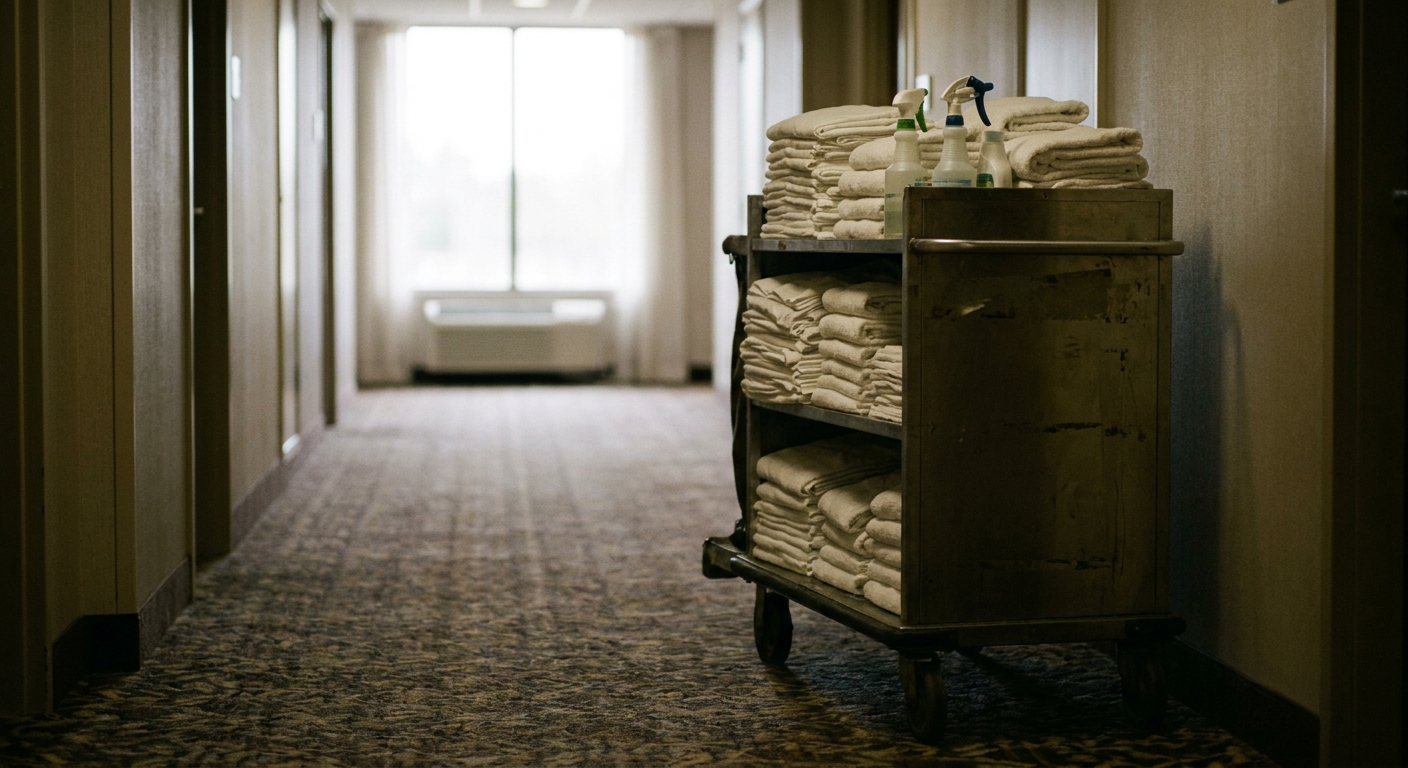
Modern housekeeping carts feature low-profile linen bins, height-adjustable handles, large all-terrain wheels, and onboard caddies that reduce reaching and lifting. Combined with fitted-sheet techniques (slip-resistant mattress lifters) and team bed-making protocols, ergonomic upgrades have been shown to reduce housekeeper strain claims by 30% to 50% in published studies.
Slip-Resistant Footwear Programs
A documented slip-resistant footwear program — where the hotel either issues or subsidizes SR-rated shoes for housekeeping, kitchen, and engineering staff — is one of the easiest credit-earners on the underwriting checklist. The program also reduces public-area slip claims because staff are more confident moving across wet surfaces.
Kitchen Safety Training
Knife handling, hot-oil management, deep-fryer protocols, and proper PPE (cut-resistant gloves, non-slip mats, heat-resistant aprons) need to be documented in writing and refreshed quarterly. Combine with a written burn-injury first-response protocol and visible signage in multiple languages, and you have the framework underwriters want to see.
Safety Committee and Return-to-Work Program
A standing safety committee with line-staff representation — meeting monthly, reviewing every incident, and feeding recommendations back to management — is the single most-cited predictor of mod improvement. Pair it with a written Return-to-Work (RTW) program that offers modified duty (think: light-duty front desk hours for an injured housekeeper) and you cut both indemnity dollars and lost-time claim severity dramatically.
How Do I Lower My Hotel's Workers' Comp Premium This Year?
There are seven proven steps a hotel general manager or owner can take in the 60 to 90 days before renewal to drive WC premium down. Each works on its own, and the cumulative effect on a $50,000 to $250,000 premium account can run well into five figures.
Pull and verify your loss runs. Request currently valued 5-year loss runs from your incumbent carrier. Audit any open reserves over $5,000 — open reserves drive your mod even when the claim is dormant. Ask your broker to push the carrier for reserve reductions on stable claims.
Run an experience modifier verification. NCCI E-Mod calculations contain errors more often than owners realize. A formal verification through your broker can identify miscoded payroll, double-counted claims, or formulas that should have been suppressed.
Reclassify miscoded payroll. Walk the property with your broker and confirm every employee's primary duty matches their NCCI code. Move salon-only staff to 8868, separate maintenance from front-of-house, and ensure shuttle drivers aren't being charged under 9052.
Document your safety committee. Carriers want minutes, attendance, incident reviews, and follow-up actions. A binder of monthly meeting records is worth a discrete credit at most carriers — typically 2% to 5%.
Roll out a slip-resistant footwear program. Subsidize SR-rated shoes for housekeeping and F&B staff. Document compliance with quarterly inventory checks. Worth a written credit on the underwriting submission.
Implement a written Return-to-Work program. Modified duty plus an in-house return-to-work coordinator (often the HR director or general manager) cuts indemnity exposure and shortens the open-claim tail.
Market the renewal 60 to 90 days out. Don't let your broker auto-renew. Submit to Berkshire Hathaway GUARD and at least one standard market every year. Competitive bidding alone — even when you stay with your incumbent — frequently shaves 5% to 10% off the indication.
What Are Connecticut's Workers' Comp Requirements for Hotels?
Connecticut requires every employer with one or more employees to carry workers' compensation insurance — there is no small-employer exemption. The mandate applies the moment a hotel hires its first paid employee, full-time or part-time, including seasonal staff.
Coverage Specifics in Connecticut
- Statutory limits — Part A coverage pays Connecticut statutory benefits with no dollar cap. Part B employers' liability typically carries $500K / $500K / $500K minimum limits.
- Officer and owner inclusion — sole proprietors and partners are exempt by default but can elect coverage. Corporate officers can elect to exclude themselves under CT law if they own at least 25% of the business.
- Independent contractors — be cautious. The state applies an ABC-style test, and misclassified housekeepers or front-desk staff who should have been W-2 will trigger uninsured-employer penalties.
- Penalties for non-coverage — uninsured Connecticut employers face fines up to $50,000 per occurrence and personal liability for any workplace injury.
When Should I Use the CT Assigned Risk Plan vs. a Standard Carrier?
The Connecticut Workers' Compensation Assigned Risk Plan is the residual market for hotels that can't get coverage in the voluntary (standard) market — typically because of bad loss history, recent severe claims, new ventures with no track record, or a mod above 1.25. The plan is administered by NCCI and the assigned carrier will always quote at higher rates than a preferred market like Berkshire Hathaway GUARD.
Use the voluntary market whenever your mod and loss runs allow. Use the Assigned Risk Plan only as a bridge — a one- or two-year placement while you stabilize losses, then re-market into a voluntary carrier as soon as your three-year history supports it.
Key Takeaways
- Hotel WC class codes 9052 (all other), 9058 (restaurant), 8868 (salon), and 9015 (maintenance) cover most hospitality payroll — assigning each employee correctly is the first place to find savings.
- Frequency hurts the experience modifier more than a single severe claim — focus loss control on routine sprains and slips, not just catastrophic risks.
- Berkshire Hathaway GUARD is the preferred carrier for hotel and motel WC in Connecticut, with bundled BOP, umbrella, and shuttle auto on the same account.
- A documented safety committee, ergonomic housekeeping carts, slip-resistant footwear program, kitchen safety training, and a written Return-to-Work program can deliver 10% to 25% in carrier credits.
- Connecticut requires WC for any employer with 1+ employee — no small-employer exemption. Penalties for non-coverage run up to $50,000 per occurrence.
- Market your renewal 60 to 90 days out — competitive bidding alone shaves 5% to 10% off most hotel WC programs.
Frequently Asked Questions
How much does workers' comp cost for a typical 100-room hotel in Connecticut?
Premiums vary widely with payroll, mod, and exposure mix, but a 100-room Connecticut hotel with $1.5M to $2M in annual payroll and a mod near 1.00 typically pays between $35,000 and $75,000 in annual workers' compensation premium. Restaurant payroll and shuttle operations push that figure higher; properties with a sub-0.85 mod and a documented loss-control program can come in 20% to 30% below the midpoint.
What's the difference between class codes 9052 and 9058?
Class code 9052 covers all hotel employees except restaurant staff — housekeeping, front desk, bellhops, valets, concierge, and laundry. Class code 9058 covers hotel restaurant employees specifically — line cooks, dishwashers, servers, bartenders, and banquet staff. The two codes carry different rates because kitchen and food-service work has a different injury profile (burns, cuts, hot oil) than the rest of hotel operations.
Do I need workers' comp for housekeepers who I treat as independent contractors?
Almost certainly yes. Connecticut applies a strict ABC test to determine independent contractor status, and housekeepers who work on the property under hotel direction, on hotel-set schedules, using hotel-supplied tools and uniforms, will fail the test. Misclassified housekeepers trigger uninsured-employer penalties, back premium audits, and personal liability for any injury. The safe answer is to W-2 your room attendants and cover them properly.
How long does a workers' comp claim stay on my experience modifier?
NCCI's experience rating window covers the three policy years ending one year before the current effective date. So a claim incurred in 2023 will appear on your mod for the 2025, 2026, 2027, and 2028 renewals before it ages off. Reserve changes during that window — up or down — affect your mod every year until the claim leaves the rating period.
Can I get a workers' comp discount for installing slip-resistant flooring?
Yes — most preferred carriers, including Berkshire Hathaway GUARD, will credit a hotel that installs slip-resistant flooring in lobbies, kitchens, pool decks, and bathrooms, especially when combined with a slip-resistant footwear program and documented inspection logs. Credits are usually written as a schedule credit on the underwriting submission and run 2% to 5% depending on the scope of the installation.
What happens at a workers' comp audit?
At year-end audit, the carrier verifies your actual payroll by class code against the estimate you provided at policy inception. If actual payroll was higher, you owe additional premium. If lower, you receive a refund. Hotels with multiple class codes need clean payroll records — employee names, job titles, and time allocations — to defend against the carrier reclassifying borderline employees into a higher-rated code.
Does Connecticut workers' comp cover a hotel shuttle driver injured in a vehicle accident?
Yes — Connecticut workers' compensation responds to any injury sustained in the course and scope of employment, including motor vehicle accidents involving shuttle vans, valet duties, or driving between properties. The third-party liability for the vehicle and its passengers falls under commercial auto, not WC, but the driver's medical and indemnity benefits are paid through the workers' compensation policy. Resort & country club auto coverage from Berkshire Hathaway GUARD coordinates cleanly with their WC product for hotels with shuttle operations.
Hotel workers' compensation is too important — and too expensive — to leave to a generic small-business policy. If you operate a hotel, resort, or country inn in Connecticut and want a broker who understands hospitality class codes, the E-Mod formula, and the difference between a preferred-market carrier and the Assigned Risk Plan, our team places hotel WC programs across all 50 states. Learn more about our full Hotels & Destination Resorts Insurance program, or request a quote for your property today. Prefer to talk first? Call us at (860) 970-0977.
Related Content
AI Payment Fraud Incident Response: What to Do First
The first hour after a fraudulent wire can decide whether funds are frozen or lost. Follow this practical response guide for banks, insurers, evidence, law enforcement, and recovery.
Read post →
Hotel and Commercial Property Insurance: Where Should Renewal Savings Go?
A practical guide for hotel and commercial-property owners deciding whether to keep renewal savings, lower deductibles, increase limits or restore coverage.
Read post →AI Fraud Insurance Exclusions: Where Coverage Can Break
A large cyber limit can hide a small social engineering sublimit. Learn how voluntary-transfer language, verification conditions, and overlapping crime coverage can affect AI fraud claims.
Read post →
Connecticut Builders Risk Insurance: 2026 Buyer’s Guide
Connecticut builders risk buyers should update project values, timelines and controls. Learn what to prepare and compare for a 2026 placement.
Read post →